


WINGX Global Market Tracker:
Airline disruptions boost bizav despite rising fuel costs
The Iran-Israel-US conflict and specifically the closure of the Strait of Hormuz has sent jet fuel prices to record highs, forcing scheduled carriers to cancel thousands of flights, raise fares sharply, and warn of worse to come.
At the same time, TSA staffing shortages across major US hubs have left commercial terminals in disarray during one of the busiest travel periods of the year.
Caught between soaring costs and collapsing service reliability, a growing cohort of travelers are turning to business aviation, and the data is starting to show it. Global bizjet activity surged +11.3% year-on-year in Week 13, even as the Middle East continues to record some of the sharpest traffic declines since the conflict began.
Global bizjet activity: How much is the Middle East dragging on global traffic?
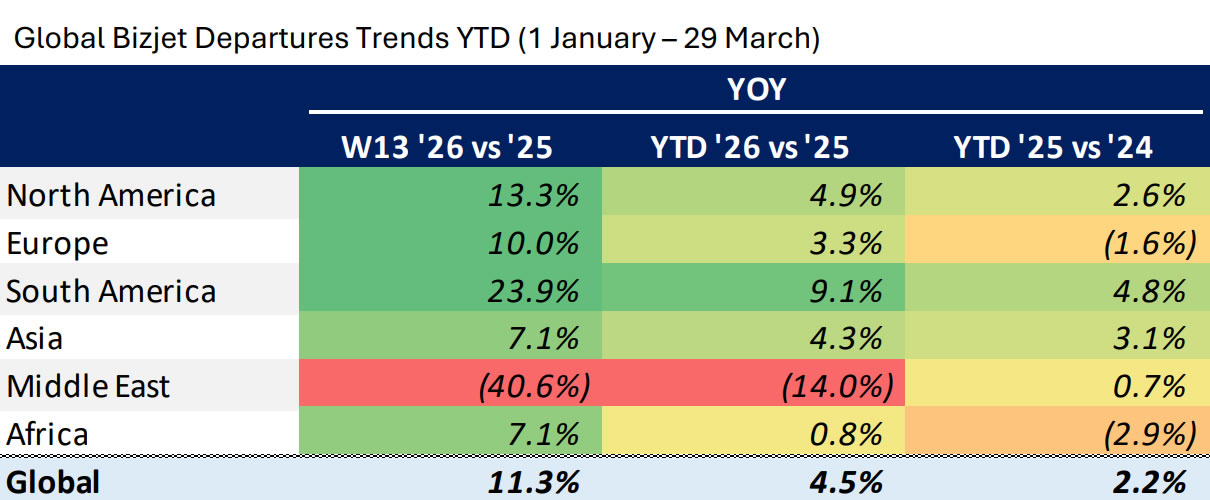
The broader bizjet market continues to demonstrate resilience in the face of the ongoing conflict. Global bizjet sectors were +11.3% YOY in Week 13, with the year-to-date figure (1st January-29 March) +4.5% ahead of last year, a notable acceleration from the +2.2% achieved over the same period in 2025 vs 2024. In the last year, WINGX data shows only 3 weeks that recorded greater than 10% weekly YOY growth (Week 45 2025, Week 2 2026, and Week 13 2026).
North America anchored weekly YOY growth at +13.3%, while Europe delivered a strong +10.0% and South America continued its standout run at +23.9%. In short, displaced commercial passengers appear to be fueling an unusually strong week for business aviation demand.
Unsurprisingly, business aviation demand in the Middle East has wilted, but with such a small footprint of global traffic, the spillover impact on worldwide trends is still small.
With the region accounting for approximately 1% of global bizjet departures in Week 13, the 40.6% year-on-year decline contributed only -0.4% to global activity.
On a year-to-date basis, the Middle East accounts for closer to its typical 2% share of global activity, meaning its cumulative -14.0% YTD underperformance has dragged the global year-to-date figure down by approximately 0.3 percentage points. Put another way, global bizjet growth would be running closer to 11.7% in Week 13 and 4.8% year-to-date were it not for the conflict's continued footprint in the region.
Global Bizjet Departures Trends YTD (1 January-29 March).
click image to enlarge
Fuel Crisis: The cost shock reshaping global aviation
More than four weeks since the conflict began on 28 February, the fuel crisis impacting global aviation operations shows no sign of abating. US jet fuel prices have more than doubled since the start of March, with jet fuel hitting $1,710 per metric ton at the end of the month, compared to just $742 a year ago, a 130% increase.
The closure of the Strait of Hormuz, through which a fifth of the world’s oil normally passes, has choked off supply and is the direct driver of the extreme price increases now cascading through global aviation fuel markets.
The consequences for scheduled aviation are severe and accelerating. According to Cirium data, close to 7% of all scheduled flights were cancelled on Monday 30th March, nearly twice the 4.7% rate recorded on the same day last year.
United Airlines has become the first major US carrier to cut flights by approximately 5%, while European carrier SAS is cancelling at least 1,000 April flights. At least for now, this disruption is obviously contributing to stronger bizjet demand.
Commercial aviation’s loss, business aviation’s gain?
The divergence between commercial and business aviation since the conflict began could not be starker, and nowhere is that more visible than across the US metros hit hardest by TSA staffing shortages.
As reported in last week's bulletin, the partial government shutdown has left roughly 50,000 TSA officers working without pay, with callout rates at some of the country's busiest hubs reaching record highs, New Orleans, Atlanta, Houston, and Washington all posting rates between 38% and 42% by 22nd March, bringing commercial terminals to a near standstill. Compounding this, fuelcost-driven airline cancellations have accelerated sharply through March, with nearly one in fourteen scheduled flights cancelled globally on 30 March alone.
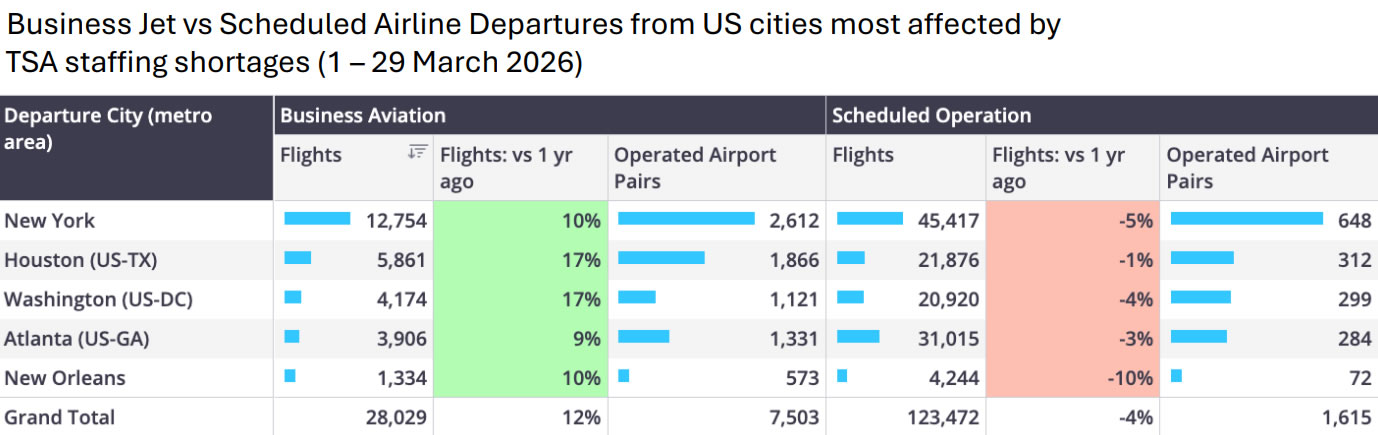
WINGX data for the 1st-29th March period across five of the most affected departure cities tells a consistent and striking story: scheduled airline departures are down across the board, while business aviation has grown in every single market. Across the five metros combined, 28,000 business jet departures were recorded, up 12% year-on-year, while roughly 123,500 scheduled airline departures declined 4%.
Houston and Washington DC led bizjet growth at +17% each, with New York and New Orleans both posting +10%, and Atlanta +9%. On the airline side, every metro recorded declines, with New Orleans the worst affected at -10%, followed by New York at -5%, Washington DC -4%, Atlanta -3%, and Houston -1%.
The pattern is consistent enough across five geographically diverse metros to suggest something more than coincidence. With commercial terminals gridlocked, schedules shrinking, and airfares climbing sharply, business aviation is absorbing at least a portion of the displaced demand, from travelers with the means to bypass the chaos. The critical question is how long that dynamic holds. If the fuel crisis persists and broader economic damage deepens, the discretionary spending that sustains bizjet demand will eventually come under the same pressure currently grounding commercial flights.
Business Jet vs Scheduled Airline Departures from US cities most affected by TSA staffing shortages (1st-29th March 2026).
click image to enlarge
Nick Koscinski, WINGX Analyst, comments: "Now more than a month into the conflict, we're seeing a tale of two aviations. Scheduled carriers are cutting flights, raising fares, and warning of worse to come, while the business jet trend has been firmly positive through March.
"The commercial aviation experience has rarely been more chaotic, with soaring fares, gridlocked terminals, and shrinking schedules, those who can afford the alternative are taking it.
"The caveat is that this is a demand tailwind built on disruption, not underlying growth, and if the fuel crisis persists long enough to put a dent in the discretionary spending that sustains bizjet demand, then even bizjets won’t be immune.”



"Now more than a month into the conflict, we're seeing a tale of two aviations. Scheduled carriers are cutting flights, raising fares, and warning of worse to come, while the business jet trend has been firmly positive through March.
"The commercial aviation experience has rarely been more chaotic, with soaring fares, gridlocked terminals, and shrinking schedules, those who can afford the alternative are taking it.
"The caveat is that this is a demand tailwind built on disruption, not underlying growth, and if the fuel crisis persists long enough to put a dent in the discretionary spending that sustains bizjet demand, then even bizjets won’t be immune.”
Nick Koscinski
WINGX Analyst
WINGX GmbH
Lilienstraße 11
20095 Hamburg
Germany.
+49 40 23 96 85 05
BlueSky Business Aviation News | 2nd April 2026 | Issue #836

| © BlueSky Business Aviation News Ltd 2008-2026 |