


WINGX Global Market Tracker:
Middle East conflict enters fourth week while Spring break and TSA chaos fuel US bizjet activity
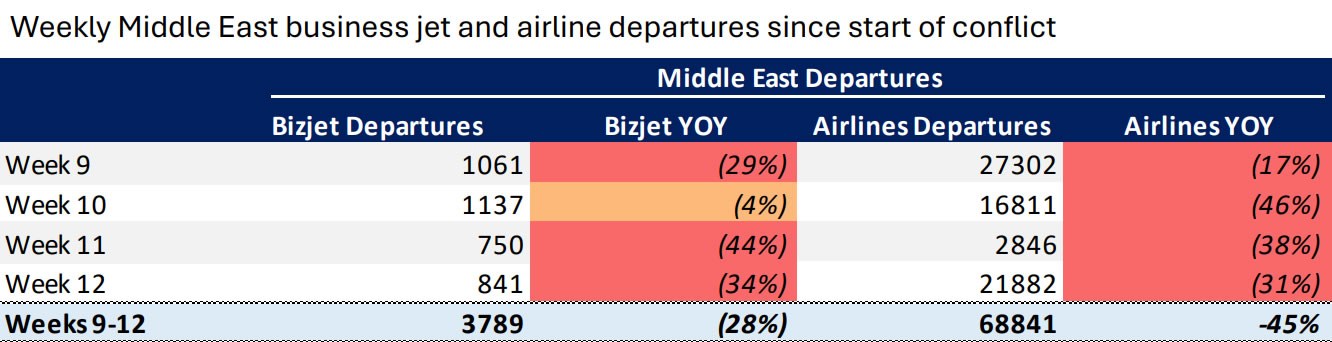
Since the outbreak of the Iran-Israel-US conflict on 28 February, Middle East business aviation remains deeply disrupted, with 3,789 bizjet departures recorded across the conflict-affected last 4 week period, a 28% year-on-year decline driven by a volatile week-by-week trajectory.
While the regional crisis continues to cast a shadow over global trends, the broader bizjet market has demonstrated resilience, with two distinctly American stories dominating the domestic picture this week. Spring break drove 5,860 bizjet arrivals across five major leisure destinations, up 10% year-on-year, as leisure demand for private aviation holds firm. Simultaneously, the partial government shutdown gripping the Department of Homeland Security has left TSA operations in disarray at major hubs, with callout rates* exceeding 40% at some of the country's busiest airports, and WINGX data showing broad-based bizjet growth across the most affected metro areas throughout the disruption period.
*Callout rate refers to the share of scheduled TSA staff failing to report for duty.
Global Executive Summary
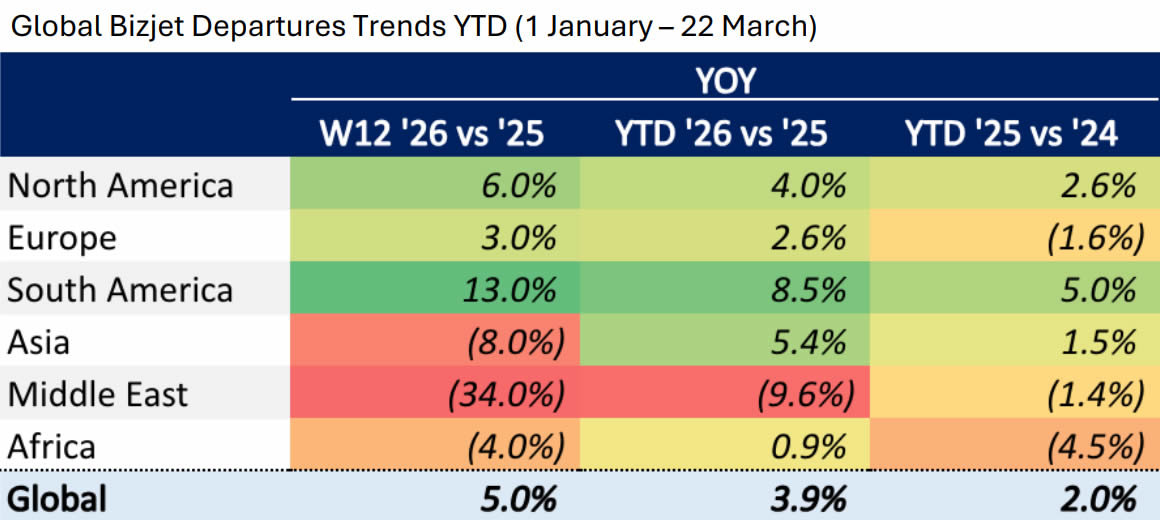
Despite headwinds from the Middle East conflict, the global bizjet market is holding steady. In Week 12 (March 16th-22nd), global business jet activity rose 2% compared to the previous week, 5% ahead of Week 12 in 2025. Year to date global bizjet departures are 4% ahead of last year, hours flown are 5% ahead of last year.
In Europe the last four-week trend is positive; departures are 3% higher than comparable last year. Switzerland and Italy recorded a boost in Week 12, departures 14% and 15% ahead of Week 15 last year.
The Middle East continues to struggle given the continuation of the US-Israel-Iran conflict, dropping 34% compared to Week 12 2025. With the Middle East accounting for 1% of global departures last week, the Middle East drug global growth down by 0.4 percentage points.
Global Bizjet Departures Trends YTD (1 January-22 March).
click image to enlarge
Four Weeks In: Middle East Aviation Counts the Cost
Since the outbreak of the in Week 9 on 28 February, WINGX data provides a clear picture of the cumulative toll on Middle East aviation. Across the four conflict-affected weeks, 3,789 business jet departures were recorded in the region, a 28% decline year-on-year, but the week-by-week progression tells a more volatile story than that headline figure suggests.
The initial shock of Week 9 produced a 29% year-on-year decline with 1,061 departures, a figure that understates the true impact given the conflict only erupted on the final two days of that week. Week 10 appeared to signal stabilization, with departures recovering to 1,137 and the year-on-year decline narrowing sharply to just 4%, however, this was most likely a representation of evacuation flights, rather than a true stabilization. Week 11 broke decisively lower to just 750 departures, a 44% year-on-year collapse and the worst week for Middle East bizjet activity since the conflict began.
Week 12 has brought a slight increase in departures week-on-week, edging back up to 841, with the year-on-year decline to 34%.
The scheduled airline picture has followed a broadly parallel but more severe trajectory. Across the same four-week window, 68,841 airline departures were recorded against a year-on-year decline of 45%, significantly deeper than the 28% seen in business aviation. The divergence is notable: bizjet operators have shown greater flexibility in managing the disruption, while scheduled carriers have borne a heavier proportional hit. The Week 12 airline figure of 21,882 departures and a 31% year-onyear decline mirrors the bizjet trend, with both segments still far from any return to preconflict operating levels.
Weekly Middle East business jet and airline departures since start of conflict.
click image to enlarge
Sun, Sand, and Private Jets: Spring Break 2026 Drives Strong Bizjet Demand
The 1-22 March spring break window has generated a clear and measurable surge in business jet arrivals across five major leisure destinations tracked by WINGX. Across Miami, Cabo San Lucas, Cancún, Panama City Beach, and Punta Cana, WINGX recorded 5,860 total bizjet arrivals, up 10% year-on-year, signaling strong leisure demand for private aviation heading into the peak spring travel season. Miami dominated in volume, while Mexico delivered a split verdict with strong gains in Cabo San Lucas offset by a decline in Cancún, while Punta Cana emerged as the year-onyear growth leader across all five destinations.
Miami led all destinations with nearly 4,000 arrivals (+7% YOY), followed by Panama City Beach (700 arrivals, +24%) and Cabo San Lucas (500 arrivals, +21%). Punta Cana was the standout leader on a year-on-year basis at +36% with 350 arrivals.
Cancún was the only destination to record a decline, slipping 8% to 350 arrivals, likely reflecting operator caution amid the escalating cartel-government conflict that has weighed on security concerns across the southeastern region of the country.
1-22 March business jet arrivals into Miami, Cabo San Lucas, Cancún, Panama City Beach, and Punta Cana.
click image to enlarge
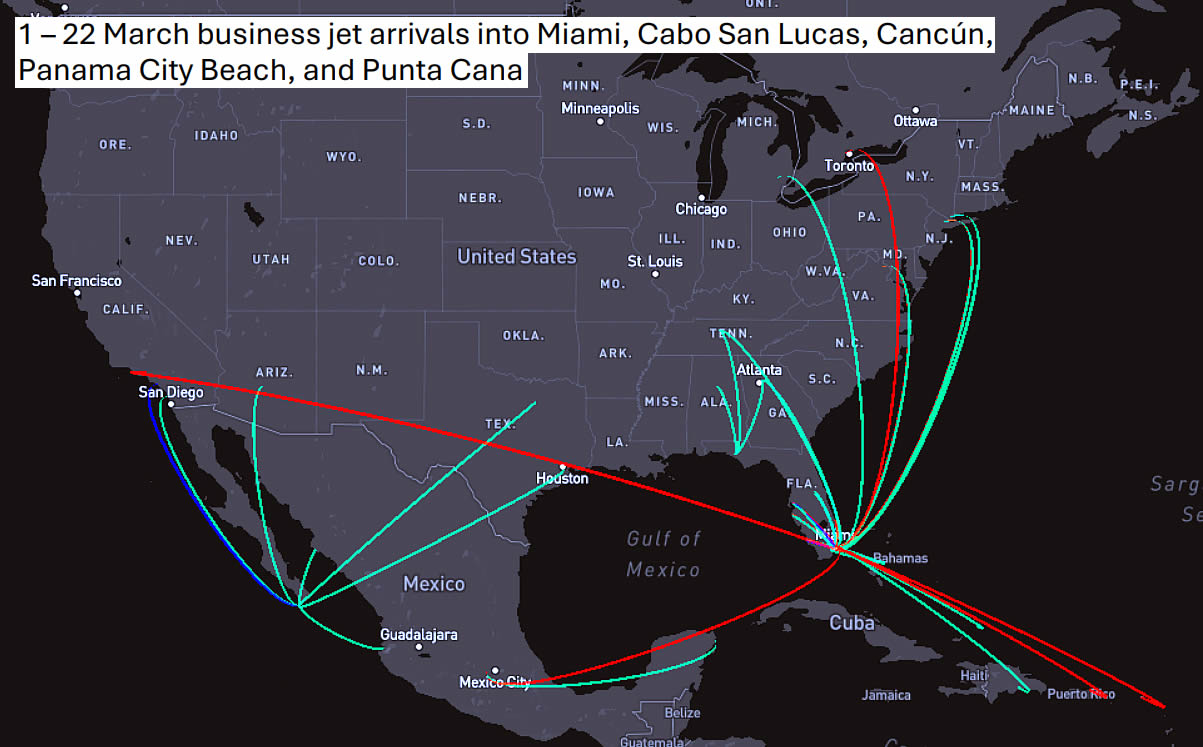
Green = YOY growth; Red = YOY decline; Blue = No record in previous year.
Private Jets: A Refuge from the TSA Storm?
The partial government shutdown that began on 14 February, leaving roughly 50,000 TSA officers working without pay, has created unprecedented disruption at major US commercial airports during one of the busiest travel periods of the year. Callout rates, the share of scheduled TSA staff failing to report for duty, at the worst-affected hubs reached record highs on 22 March, with New Orleans Louis Armstrong and Atlanta’s Hartsfield-Jackson posting 42%, Houston George Bush Intercontinental 39%, and Baltimore/Washington 38%.
In Houston, wait times exceeded four hours with warnings looping through terminals advising passengers they may not clear security in time for their flights. Philadelphia closed three security checkpoints entirely, New York's LaGuardia saw TSA wait times stretching beyond two hours, and San Diego saw lines stretching to the sidewalk. The situation has prompted the Trump administration to deploy ICE agents to the most severely affected airports in an attempt to relieve the backlog.
Against this backdrop, WINGX data shows broad-based growth in business jet departures across most of the affected metro areas in the 14 February-22 March window. New York led in volume with nearly 15,500 departures (+2% YOY), followed by Houston with 6,750 departures (+5%) and Washington DC with 5,000 departures (+7%). Atlanta recorded 4,800 departures (+5%) and San Diego nearly 2,900 departures (+7%). New Orleans posted the strongest growth of any metro in the dataset at +11% with 1,700 departures, while Baltimore reached 1,100 departures (+10%). Philadelphia was the sole market to decline, slipping 1% to 2,170 departures.
Across most metros, the data points to a consistent pattern of bizjet growth throughout the period of deepening commercial disruption, suggesting that for those who can afford it, business aviation could have served as a refuge from the uncertainty and hours-long queues plaguing the commercial terminals.
Nick Koscinski, WINGX Analyst, comments: "Now almost four weeks into the conflict, the Middle East bizjet market is still struggling to find its footing, with no clear resolution to the conflict on the horizon.
"On the other side of the world, the US market is telling a very different story. Spring break delivered a strong 10% jump in bizjet arrivals across our five tracked leisure destinations, and while we can't say for certain that the TSA chaos is driving people to private jets, most major affected metros saw bizjet growth during the disruption period, so it's hard to imagine that's entirely a coincidence."



"Now almost four weeks into the conflict, the Middle East bizjet market is still struggling to find its footing, with no clear resolution to the conflict on the horizon.
"On the other side of the world, the US market is telling a very different story. Spring break delivered a strong 10% jump in bizjet arrivals across our five tracked leisure destinations, and while we can't say for certain that the TSA chaos is driving people to private jets, most major affected metros saw bizjet growth during the disruption period, so it's hard to imagine that's entirely a coincidence."
Nick Koscinski
WINGX Analyst
WINGX GmbH
Lilienstraße 11
20095 Hamburg
Germany.
+49 40 23 96 85 05
BlueSky Business Aviation News | 26th March 2026 | Issue #835

| © BlueSky Business Aviation News Ltd 2008-2026 |