


 |
Why aviation innovation must go
|

The word “innovation” has become ever more closely associated with technology. Across aviation, discussions about the future quickly turn to AI, automation and digitalisation. These developments have significant potential, but they are only part of how our industry can innovate.
For airports, innovation should start with understanding the problems that need solving. We can then determine the appropriate response. In some cases, technology will play a central role. In others, progress may come through infrastructure changes, new approaches or closer collaboration across the industry.
This broader view of innovation is increasingly important as aviation considers how it can become more efficient and resilient while preparing for the future.
Start with the problem
A practical approach is particularly important in business aviation, as airports need to respond to changing operational requirements while working within an environment where safety and regulation quite rightly shape what we can do.
At London Biggin Hill Airport, we look for where we can make a genuine difference for the customers, clients and businesses using the airport, then work back from there.
Our recent work on a new approach to Runway 03 is a good example. In April, the airport launched a full, Civil Aviation Authority-authorised trial of a new satellite-based approach to the runway using dual sector radius-to-fix. This is the first approach of its kind in the UK and follows investment in our runway infrastructure, including LED centreline lighting and an Instrument Runway Visual Range system.
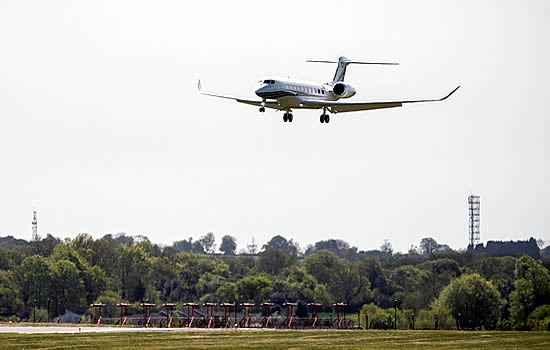
Qatar Executive G700 on final approach to Runway 03 at London Biggin Hill Airport.
While the innovation is exciting, the important part is what those developments can achieve in practice. Investing in the runway itself was only one part of the equation; how aircraft access it and how that fits within the wider airspace environment matters too. Together, these developments give pilots greater flexibility and support reliable, resilient operations at London Biggin Hill across a wider range of conditions.
Working with the wider industry
Of course, no airport operates in isolation.
The work around the Runway 03 approach has required close engagement with other airports and organisations because any changes to airspace need to be introduced carefully. Collaboration with the wider industry has therefore been an important part of the process. I will surprise no-one by pointing out that London’s airspace is congested. Making the new approach a reality has involved collaboration, understanding and agreements with Heathrow, Gatwick, IFP designers, NATS, the CAA and key stakeholders.
We take a similar view when looking at our infrastructure. Airports are long-term assets. The decisions we make today must consider how aircraft and operators may use the airport in the years ahead.
London Biggin Hill is home to more than 70 aviation and aerospace businesses. Bringing that breadth of expertise together at the airport gives us direct insight into the variety of challenges the industry is facing.
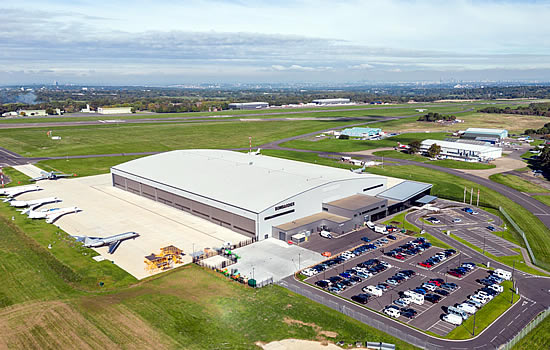
London Biggin Hill is home to more than 70 aviation and aerospace businesses. Shown here, Bombardier's 51,000 sq. ft. European Service Centre.
For me, that is an important part of innovation. Good ideas often come from listening to the people who deal with these challenges every day and understanding what would help them deliver for their customers.
Developing the right skills
We also need to think about the people who will be working in aviation in ten or 20 years' time, taking the industry forward.
AI and other emerging technologies will undoubtedly influence their careers. But we don’t know exactly what tools they will be using or what challenges they will face, which is why adaptability matters.
Our Futures Week programme at London Biggin Hill allows young people to experience the range of careers available across aviation and aerospace and connect with people already working in the industry.
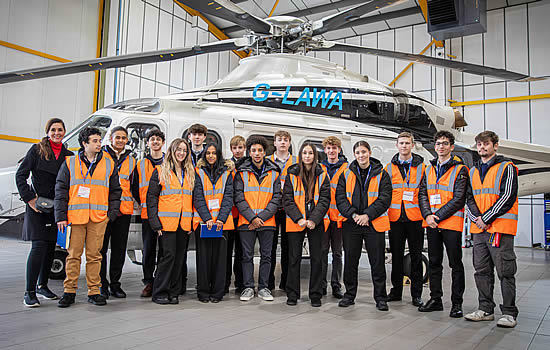
London Biggin Hill Airport Futures Week - inspiring young people interested in aviation.
Technical skills matter, but so does a willingness to ask questions and look at a problem differently. We need people in aviation who are comfortable with change and confident enough to challenge the way things have always been done.
We need to embrace the technology being used by the young people we are endeavouring to recruit into our industry. We need to be able to relate to them to create an environment in which they can flourish.
Engagement beyond the industry
Innovation also requires us to look beyond the airport and the aviation industry itself.
For business aviation to develop, there needs to be a strong understanding among policymakers and decision-makers of how the sector operates, the benefits it brings, opportunities it creates and the challenges it faces. As an industry, we have a responsibility to support that understanding through open and constructive engagement.
That means being willing to have conversations and give government representatives the opportunity to see our operations first-hand. The same applies to the communities around us. We need to listen and answer questions, as we would with industry stakeholders.
This may not be innovation in the traditional sense, but finding better ways to engage, educate and bring people into the conversation can be just as important to progress as introducing a new technology.
Keeping innovation practical
There will be no shortage of new technology coming into aviation over the next few years, and airports must be ready to use it where it can improve operations.
But being the very first to adopt new technology for that reason alone is not the goal.
For me, the test is much more practical. Does it solve a problem? Does it make the airport work better for our customers, clients and businesses?
If we keep asking these questions, innovation remains focused on what matters: making aviation work better for everyone.

“Being the very first to adopt new technology for that reason alone is not the goal. The test is much more practical.
"Does it solve a problem? Does it make the airport work better for customers, clients and businesses?”
“Good ideas often come from listening to the people who deal with these challenges every day and understanding what would help them deliver for their customers.”
"We need people in aviation who are comfortable with change and confident enough to challenge the way things have always been done."

BlueSky Business Aviation News | 15th October 2026 | Issue #862
