


 |

Dawit Lemma, Chairperson of AfBAA explains why the AfBAA research project is so important for African business aviation and beyond.
In 2025, the African Union backed a call for governments and international organizations to stop using the familiar Mercator map of the world. The 16th-century graphic stretches the world near the poles to ensure they are featured; as a result, many geographic features are distorted. Africa appears smaller than it should, and Greenland looks bigger, even though Africa is 14 times larger.
The result is a genuine misconception about how vast the African land map is. The African Union argued that this undermines the perception of its importance on the global stage by obscuring its spatial complexity and, in turn, its opportunities.
This perception can easily spill, and often does, into every aspect of the continent's economic, social, and cultural importance. The perception is that it’s a small continent, comprising small countries, when nothing could be further from the truth.
In fact, the African continent is large enough to accommodate the landmass of China, the USA, the UK, Japan, India, Eastern Europe, Germany, France, Spain, and Italy, plus others. Only with this visualization can you appreciate the continent's vastness and its incredible potential.

Rotary aircraft are an important component of African business aviation | Photo Paul Ludick.
Social and economic growth are undeniably driving the continent forward, and business, commerce, and investment underpin this development. Yet rail and road infrastructure cannot connect the continent's 11.7 million square miles and commercial air travel is still limited in terms of freedom of flight.
This is where business aviation fills the gaps.
The growth is exponential, and to effectively meet the demands of a dynamic, transforming African economic community, as well as to meet the needs of a rapidly changing business aviation sector, we need to understand where we stand, where the gaps are, and what the future holds.
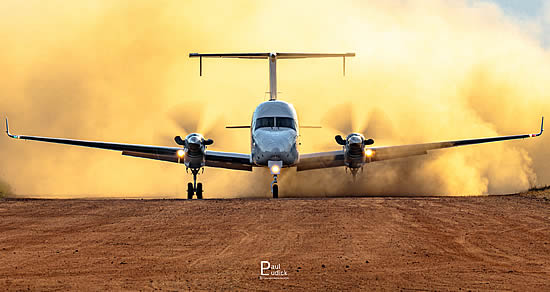
Business aviation in Africa supports access to remote locations | Photo: Paul Ludick.
That is why we launched an ambitious three-phase research project to broaden the industry’s view of the African business aviation landscape and turn anecdotes into actionable intelligence. As the organization representing the industry, its stakeholders, and our members, we want to support our continent’s growth; but without knowing where we are now, it is hard to navigate the future.
We currently lack data points for business aviation; consequently, anecdotes remain our baseline.
Our plan is to take a holistic approach, combining qualitative and quantitative information to deliver rich, trusted, independently sourced data. We anticipate that the targeted research will support industry professionals operating on the continent by replacing assumptions with facts. This will enable informed decision-making, support better operations, and drive partnership decisions in a region where demand is fragmented, regulations vary, and infrastructure quality is uneven.
It will change how business aviation is perceived, operated, and delivered. It provides an opportunity to evolve, adapt, and adopt key strategies that as yet remain unidentified.
We are in the very early stages of the research, and consequently, we don’t know what we don’t know. But our aim is to generate data that will help all stakeholders operating in Africa. If the research can influence large representative organizations as well as smaller local regulatory bodies, we will raise the game for business aviation. It is time to demystify African business aviation and encourage those who can influence business aviation, both across Africa and beyond, to use the findings to change the narrative.

The African continent is large enough to accommodate the landmass of China, the USA, the UK, Japan, India, Eastern Europe, Germany, France, Spain, and Italy, plus others.
Only with this visualization can you appreciate the continent's vastness and its incredible potential.
BlueSky Business Aviation News | 3rd September 2026 | Issue #856
