


Washington, DCNBAA: Government-industry collaboration key to workable |
The National Business Aviation Association has commended two government agencies for reflecting input from NBAA and other industry stakeholders in the collaborative process that has produced a final rulemaking for mandatory replacement of radio altimeters (RAs) in tens of thousands of aircraft.
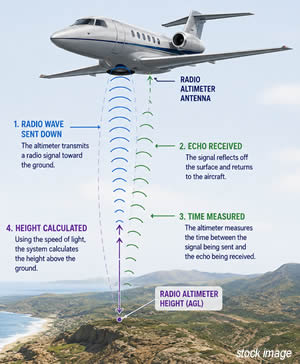
A radio altimeter provides real-time, height-above-terrain altitude data that supports critical flight crew decisions and operations, while also feeding key data to numerous safety-critical aircraft systems.
 The expected requirement to replace the device stems from a Federal Communications Commission (FCC) proposal to expand wireless telecommunications into the Upper C-band (3.98-4.2 GHz), a portion of the frequency spectrum used by aircraft altimeters for safety-data transmission. The agency intends to auction portions of the Upper C-band frequency, potentially for billions of dollars.
The FAA, in turn, has issued a mandate for the aviation sector to install new RAs, hardened against interference from signals introduced into the Upper C-band by non-aviation entities. An estimated 58,500 radio altimeters will require replacement.
NBAA and other groups worked as a united coalition to provide technical guidance to inform the rule, while also detailing concerns over replacement RA costs and timelines. The FAA’s mandate, published July 31st in the Federal Register, reflects the industry’s guidance and responds to its concerns.
For example, the FCC filing outlines a rebate program, sought by NBAA and others, to help offset operators’ equipage costs. The rebate will be funded by proceeds from the upcoming FCC’s Upper C-band frequency auction.
Equally important, the new mandate addresses the need for a reasonable installation timeline by providing certain business aircraft operated under Part 91, and all Part 135 aircraft, nearly a decade - until October 31st, 2034 - o equip with suitable radio altimeters. (Part 121 commercial airline operators must equip their aircraft by Dec. 30, 2030.)
“The radio altimeter rebate is a vital component of any equipage mandate, and a clear win for our members,” said NBAA Vice President of Air Traffic Services and Infrastructure Heidi Williams. “Radio altimeter modifications or replacements can represent a substantial, unplanned expense, and ensuring that all affected operators have access to this funding will help accelerate equipage, support compliance and preserve access to the nation’s aviation system.
“We also appreciate the FAA and FCC for working closely with NBAA and others to develop a practical timeline for radio altimeter equipage that protects safety while recognizing the significant impact on aircraft operators,” Williams continued.
The association plans a dedicated session to thoroughly address all aspects of the RA mandate as part of its annual NBAA Business Aviation Convention & Exhibition (NBAA-BACE) on Tuesday, October 20th, at 2:45 p.m. PT, on the Flight Deck, located on the show’s exhibit floor.



BlueSky Business Aviation News | 6th August 2026 | Issue #854
