


 |

Medical aviation, in most cases, implies an immediate response to the situation. If there is an indication that a patient should be transferred to another facility, people expect a medevac helicopter or jet to arrive promptly, with a crew prepared to begin immediately.
In France, the reality is more structured. Medical flights operate within a system in which aviation capabilities, healthcare protocols, and regulatory requirements must align before a mission can begin.
Therefore, the answer to the question at hand should be viewed from another angle, as France undoubtedly has the means, technology, and infrastructure to provide a proper response in a timely manner. However, does France have a properly structured system to enable efficient medical evacuations and transportation?
Aviation infrastructure in France
From an aviation perspective, France can be considered prepared to provide medevacs, as the country is known for its comprehensive network of airports with varying capacities and specializations. These facilities, combined with the wide range of aircraft used for transportation, enable medevac procedures to be performed effectively and safely, provided the mission plan is properly coordinated and organized.
At the center of this system, Paris Le Bourget Airport, Paris Charles de Gaulle Airport, and Paris Orly Airport each play distinct roles. Le Bourget is the primary airport for dedicated air ambulance flights, offering the flexibility and speed these missions require.

By contrast, Charles de Gaulle and Orly, due to their high traffic levels, are less suited to accommodating ambulance aircraft. They are more commonly used for medical escort flights on scheduled services, where patients travel with medical teams on commercial airlines.
Beyond the capital, France offers strong regional coverage for medical flights. In Lyon, Lyon-Bron Airport positions itself as a business aviation airport, making it a suitable option for dedicated air ambulance operations, similar in role to Le Bourget.
Meanwhile, Lyon–Saint-Exupéry Airport, as a major commercial hub, is more commonly used for medical escort missions on scheduled flights rather than dedicated ambulance aircraft.
Nice Côte d'Azur Airport is another good option, especially for international air ambulance flights, as it is close to medical centers in Nice. However, its mixed commercial and business aviation traffic can complicate operations, as the facility experiences heavy congestion during peak months. Therefore, using Nice airport during the summer may be quite challenging.
Other airports worth mentioning include Bordeaux-Mérignac Airport and Toulouse-Blagnac Airport, both of which facilitate international travel and medical flights. Marseille Provence Airport is another option, offering easy access and proximity to local medical centers.
Medevac’s priority amidst challenges
Overall, France has a good network of airports that enables the safe, timely execution of medevac missions. The problem is that not all of them are as easy to use or offer as much immediate operational flexibility as Le Bourget Airport in Paris.
Why?
Well, firstly, operating hours matter. Many smaller regional airports in France are not open 24/7 or require prior notice for out-of-hours movements. In a medical context, that alone can delay a mission or force a rerouting to a larger airport.
Ground handling capability is another constraint. Medevac flights require immediate access to the aircraft by ambulances. Not every airport can guarantee that level of access, particularly during busy periods or outside standard operating hours.
Proximity to hospitals and overall airport congestion also play a role, particularly at mixed-traffic airports where slot availability can affect responsiveness.
At the same time, it is important to recognize that medical flights do benefit from operational priority once they are in the system. Air traffic control will typically give medevac aircraft priority handling, allowing for more direct routings, reduced holding, and expedited departures or arrivals when possible. However, this priority applies primarily at the flight execution stage.
It does not override constraints related to airport operating hours, ground handling availability, aircraft preparation, or hospital coordination. In practice, priority improves efficiency once the mission is underway, but it does not eliminate the need for the preparatory steps that define how quickly a flight can be launched.
A system shaped by healthcare, not just aviation
One of the defining characteristics of medical aviation in France is its integration with the national healthcare system. Unlike other segments of aviation, where decisions can be made quickly based on commercial considerations, medevac operations depend on clinical validation.
A transfer begins with a medical decision. The treating physician must determine that the patient requires relocation, that the benefits outweigh the risks, and that the patient is stable enough to travel. At the same time, a receiving hospital must confirm that it can accept the patient and provide the necessary care upon arrival.
This coordination ensures continuity of treatment, but it also creates a structured process that cannot be shortened without affecting coordination. Even when an aircraft and airport are available, a mission cannot proceed without medical alignment.
From an aviation standpoint, this can be perceived as a constraint. From a healthcare perspective, it is a safeguard. It ensures that medical flights are not only fast but also appropriate.
The result is a system where aviation readiness is only one part of a broader operational equation.
The importance of bed-to-bed logistics
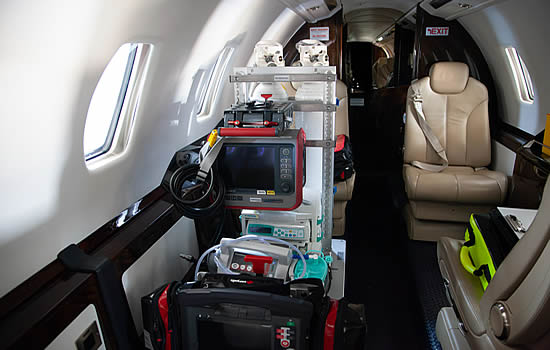
The concept of “bed-to-bed” transfer is often used in medical aviation, but in practice, it highlights one of the most complex aspects of the operation. A medical flight is not a standalone event. It is a continuous chain connecting two medical environments via a combination of ground and air transport.
While major cities in France boast well-developed airport networks and ambulances can be easily dispatched to airport aprons, the situation changes significantly in rural areas. In this case, the patient may reside far from airports, and local medical centers may have limited availability of specialized medical transport. As such, distance may become another factor restricting the feasibility of medevac in a given area.
Outside these environments, variability increases. The distance between hospitals and suitable airports may be greater. The availability of specialized ground ambulances may be more limited. Local infrastructure, including road networks and traffic conditions, can introduce unpredictable delays.
This means that the overall timeline of a medical mission is often defined by its most constrained segment. The flight itself may be efficient, but if the ground component is delayed, the entire operation is affected.
A structured framework
France’s aviation infrastructure is, by most measures, capable of supporting a mature and reliable medevac industry. The country has the physical assets, the technical expertise, and the operational experience required to carry out complex medical transfers.
What defines its readiness is the framework within which these elements operate. Medical aviation in France is structured, regulated, and closely tied to the healthcare system. This ensures a high standard of care, but it also limits flexibility in situations where a rapid, unstructured response might otherwise be possible.
In practice, this results in a system that performs consistently when processes are followed and coordination is achieved. It is less adaptable to scenarios that require immediate action without prior alignment.
This is not necessarily a weakness. It reflects a set of priorities. France’s approach emphasizes patient safety, clinical continuity, and regulatory compliance over speed alone.
A measured form of readiness
The question of whether France is “ready” to support the medevac industry depends on how readiness is defined. If it is defined as the ability to move a patient at any moment, without constraint, then no system fully meets that expectation.
If it is defined as the ability to deliver safe, coordinated, and medically appropriate transfers within a structured framework, then France is well-equipped.
The strength of the system lies in its predictability. Each step, from clinical approval to airport selection, follows a defined process. This reduces uncertainty and ensures that medical flights are integrated into the patient’s broader treatment plan.
At the same time, this structure introduces friction. It requires coordination, communication, and time. The system does not eliminate urgency, but it manages it.
In the end, France’s aviation infrastructure does support the medevac industry, not by prioritizing speed above all else, but by ensuring that every movement aligns with the patient’s clinical pathway.