

 |

Beyond the runway: how business aviation airports are evolving into integrated aviation ecosystemsBy Robert Walters, Commercial Director, |
Business aviation airports have traditionally been defined by runway access and aircraft movements. While these remain essential, they no longer offer a complete picture of the industry’s complexity and demands.
Aircraft are flying more frequently. Fleets are increasingly professionally managed. Operators are under greater pressure to maximise utilisation. In this environment, a readily reachable airport alone is not enough, as aircraft turnaround time and planning certainty now play equally important roles. The focus is shifting from solely the runway to the wider operating environment that surrounds it.
The operational value of a concentrated MRO ecosystem
For operators, maintenance is not a separate activity from flying, but part of the same operating cycle, with the structure of maintenance and engineering support directly affecting aircraft availability, scheduling and cost. This makes the location and organisation of those services a key asset.
Concentrating maintenance, avionics, interiors, engineering and specialist support capabilities in one location changes how aircraft are managed. It enables work to be completed on-site rather than across multiple facilities. Aircraft can arrive and complete multiple workstreams in a single visit, delivered as part of a continuous process rather than separate events.
At London Biggin Hill, our site is home to more than 70 complementary aviation businesses. We have nurtured an ecosystem of innovation and engineering specifically to address the needs highlighted by our operators. This proximity of support services reduces major repositioning and shortens turnaround times, improving efficiency and reducing delay risk by giving operators greater control over planning.
The benefit is equally important for OEMs. A concentrated ecosystem offers a more controlled environment to deliver aftermarket support, as immediate access to specialist capability and supply chain improves consistency and reduces variability in delivery.
OEM investment as a marker of ecosystem strength
The strength of this ‘one-stop shop’ operating model is reflected in where OEMs choose to invest.
Europe remains one of the most significant global MRO regions, accounting for more than 30% of the global aircraft MRO market. This position makes a strong regional presence essential for OEMs, and for business aviation hubs. It reinforces the importance of developing robust maintenance capability alongside runway access.
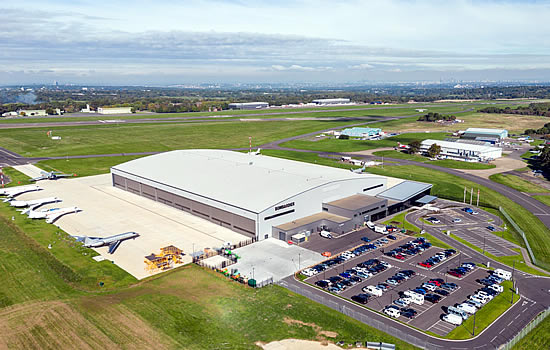
Bombardier's facility at London Biggin Hill Airport.
Last year, Bombardier announced the expansion of its European Service Centre with a new 51,000 sq. ft, two-bay paint facility at London Biggin Hill, representing one of the largest OEM MRO presences in Europe. These facilities allow scheduled and unscheduled maintenance, modifications, avionics installations and full exterior refinishing to be carried out on-site, enabling aircraft to complete multiple workstreams within a single visit.
This reduces downtime and simplifies logistics for operators, while for Bombardier it provides a base that combines infrastructure and skilled labour with an established ecosystem of specialist providers, supporting consistent delivery of aftermarket services in a key regional market.
The impact extends beyond operational efficiency. The paint facility, on target to be operational in summer 2026, will create more than 50 skilled roles, contributing to the airport’s wider economic impact.
Investment at this scale requires confidence both in infrastructure and the long-term availability of skilled people to support it, reinforcing the importance of developing capability and workforce in parallel.
Sustaining capability through skills and people investment
While infrastructure and ecosystem depth are critical, the availability of skilled engineers and technicians is becoming a defining constraint across the MRO sector. Without a strong workforce pipeline, capacity cannot expand, regardless of investment in physical infrastructure, making long-term skills development fundamental.
Across the aviation industry, demand for skilled professionals continues to grow, placing greater emphasis on how leading companies develop and retain talent over time. Addressing this requires early engagement, clear pathways into the sector and sustained investment in training.
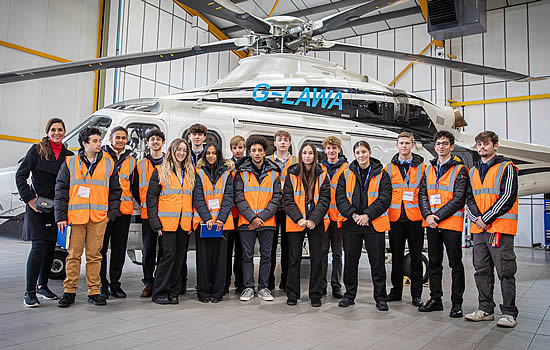
London Biggin Hill Airport Futures Week - inspiring young people interested in aviation.
At London Biggin Hill, initiatives such as Futures Week, alongside apprenticeships and outreach work with local schools and colleges, are focused on developing this pipeline. By bringing students on-site and exposing them to a range of industry roles, the aim is to connect education with real-world aviation careers and encourage participation in the sector.
This is not a short-term requirement, but a long-term condition for maintaining capability in a high-skill, demanding sector.
The evolving role of the business aviation airport
The role of the business aviation airport is changing. Runway access remains vital, but it is no longer the defining factor in how operators and manufacturers select where to base activity. A key asset is the ability to support the full operating cycle of the aircraft in one place, combining airside performance with integrated maintenance, engineering and operational support.
As business aviation continues to evolve, airports that combine access with capability will be better positioned to support the industry’s growing demand and build a resilient future. This is what increasingly defines long-term value in the sector, and where London Biggin Hill is leading the way.


BlueSky Business Aviation News | 7th May 2026 | Issue #841
