


 |

Business aviation’s ability to turn potential into profit in Africa is constrained by a lack of certified MRO facilities, supply of critical components, and local technical staff, but things are changing. Dawit Lemma, Chair of AfBAA, talks with members to explore the situation.
There is no doubt that the African business aviation sector is bursting with potential, having transitioned from a niche sector to a vital tool for economic development over the past decade, but further growth is restricted by a range of MRO limitations, which directly impact operations and business development.
Ester Henga, Business Development Manager of Nairobi-headquartered Shujaa Aviation, an African aviation service provider, outlines the problem: “There is limited availability of certified MRO facilities for certain aircraft types and specialised equipment in East and Central Africa, often requiring us to ferry aircraft to other regions. We also suffer long lead times and supply chain constraints for critical spares and components, especially for less common business aircraft models.”
The problem is intensified by the complexity of regulations and approvals when coordinating cross-border maintenance, with oversight standards and documentation requirements varying widely across African states.

MRO available at EAN in Lagos.
These views are echoed by Oluwaseun Ayodeji, Chief Operating Officer, VMO Aero Ltd, a private jet acquisition and management company in Nigeria. “Lagos serves as a major hub for business aviation in West Africa, but the MRO landscape remains constrained by structural capacity gaps. There are limited OEM-aligned or fully equipped MRO facilities in Nigeria, and most heavy maintenance requirements are still outsourced to Europe, Mexico, or the US. From my perspective, across the region, MRO infrastructure has not kept pace with fleet growth and utilisation, which continues to drive reliance on external markets.”
Most critical components have to be sourced from the US, Europe, and other external markets due to limited OEM technical support, limited local inventory, and an underdeveloped regional supply chain. Ayodeji adds: “Importation processes further compound these challenges. Aircraft parts and components are often subject to delays in customs clearance, even when classified as time-sensitive. At the same time, the predominantly USD-denominated nature of maintenance and parts procurement introduces foreign exchange constraints, which can delay payments and disrupt maintenance schedules.”
Both operators also cite a lack of local technical knowledge as another critical constraint. Henga says, “There is insufficient local availability of type-rated engineers and avionics specialists, leading to reliance on fly-in teams and higher costs.”
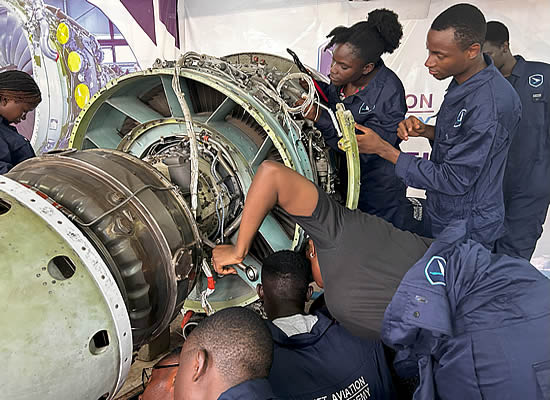
Joramco Aerojet Aviation Training Academy at Kotoka International Airport in Accra, Ghana is a good example of MRO investment.
Ayodeji expands: “While Nigeria has established aviation training institutions, access to specialised type-rating for engineers on modern business aircraft platforms remains limited. As a result, operators frequently have to send engineers abroad for certification and recurrent training.”
Overall, MRO constraints lead to increased aircraft downtime, higher operating and positioning costs, and reduced safety margins. Fleet availability is reduced, which affects service reliability and revenue generation, and ultimately creates a more cautious environment for fleet expansion.
In the short term, business aviation operators across the continent are managing with a combination of proactive planning of maintenance windows into flight support solutions, maintaining USD-based maintenance reserves, building networks of trusted MRO partners across Africa, the Middle East and beyond, and improving local line maintenance capacity where possible.
The long-term solution requires developing regional MRO hubs across Africa, strengthening local aircraft component supply chains, increasing OEM presence, accelerating customs clearance processes for aviation materials, improving access to foreign exchange, and expanding local training and type-rating capacity for engineers.
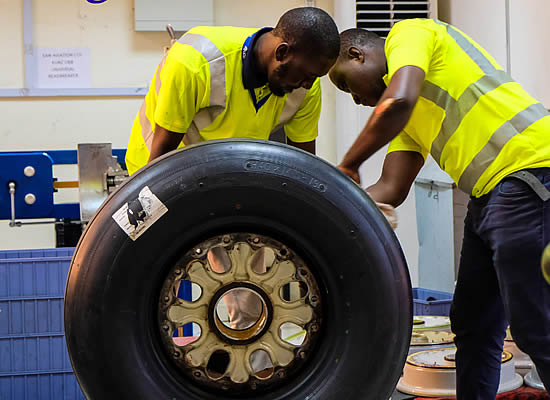
EAN MRO team.
Things are improving. Countries across Africa are investing in new maintenance facilities and expanding their service offerings, with a focus on workforce development, infrastructure improvement, and adoption of international maintenance standards. These investments demonstrate the growing recognition of the importance of developing local MRO capabilities within the continent.
The African Business Aviation Association (AfBAA) is supporting this development in a number of ways: working with members, international suppliers, and affiliated authorities to highlight the practical constraints; advising on best practices; and providing a unique platform for dialogue between operators, MROs, regulators, and financiers, both in Africa and across the world.
Ayodeji concludes: “We see strong potential for AfBAA to further advocate for policy and regulatory frameworks that support regional MRO development and mutual recognition of approvals, as well as facilitate collaborative training initiatives and partnerships between OEMs, MROs and member companies to build African technical capacity.”
Henga comments: “AfBAA continues to play an important role in advocating for improved MRO infrastructure across Africa, facilitating engagement between operators and service providers, and supporting policy dialogue with regulators. Beyond these structured efforts, the consistent conversations, stakeholder engagements, and industry touchpoints alone are already driving top-of-mind awareness around the MRO gap across the continent. That level of visibility is critical, as it keeps the issue active within decision-making circles and brings key stakeholders into the conversation.”



BlueSky Business Aviation News | 16th April 2026 | Issue #838
