


WINGX Global Market Tracker:
No relief in sight: Middle East records big drop in flights as fuel costs double
Three weeks into the Iran-Israel-US conflict, Middle East business aviation has recorded its worst week yet, with bizjet departures down 44% year-on-year in Week 11 (ending 15th March), surpassing even the initial shock of Week 9 and confirming that the partial stabilization seen in Week 10 was short-lived.
Jet-A fuel prices are continuing to climb across all major benchmarks with Arab Gulf pricing now more than double pre-conflict levels. Turkey has emerged as the defining transit hub for bizjet flights out of the Middle East. Our analysis since the start of March is that some of these aircraft are heading onto Western Europe but many others staying put, or even heading back to the Gulf. Global bizjet activity is still resilient, 4% up in Week 11; Middle East activity drop has taken only 0.4% off worldwide trends.
Middle East bizjet departures: Week 11 2026 vs last year
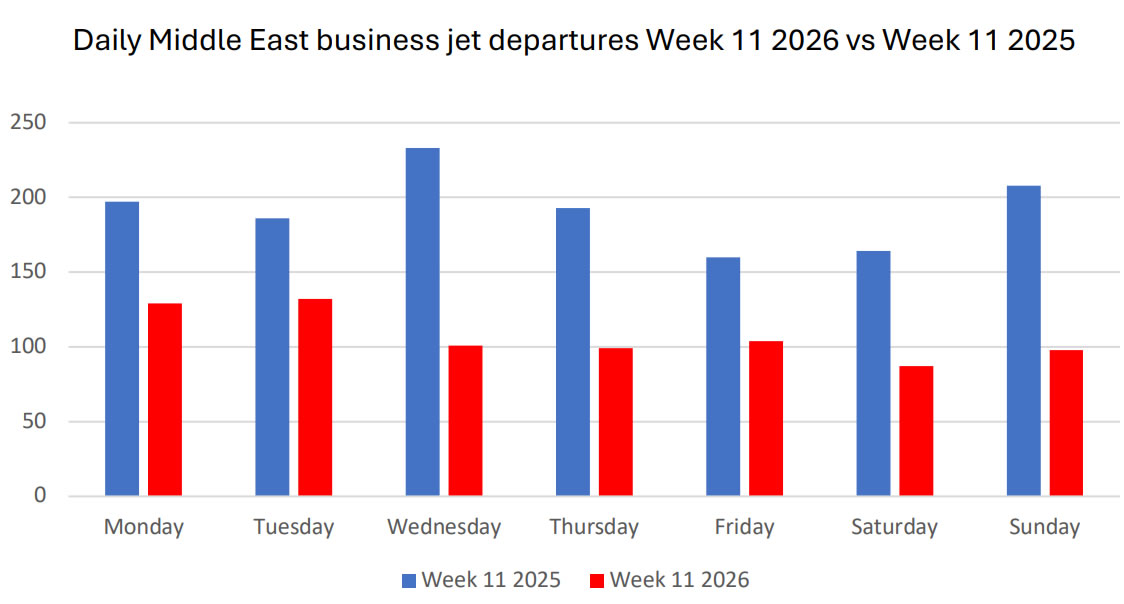
Chart 1 below compares Middle East business jet departures day-by-day for Week 11 2026 against the equivalent week in 2025, the third consecutive week of conflictaffected data in WINGX's tracking.
Week 11 2026 (9-15 March) marks the largest downturn for Middle East bizjet departures since the conflict began. With 750 total departures against approximately 1,100 in Week 11 2025, the region recorded a 44% year-on-year decline, deepening sharply from the -4% recorded in Week 10 and surpassing even the -29% collapse of Week 9. The progression across the three conflict-affected weeks tells a concerning story: Week 9's initial shock saw roughly 1,050 flights and a 29% decline, Week 10 showed apparent stabilization at over 1,100 flights and just -4%, but Week 11 has broken decisively lower to 750 flights. The brief recovery seen in Week 10 has not held.
Day-by-day, 2026 departures ran consistently below 2025 levels throughout the entire week, with no single day showing any sign of recovery. Saturday recorded the lowest daily total at just 87 departures, while no day reached over 135 flights.
Daily Middle East business jet departures Week 11 2026 vs Week 11 2025.
click image to enlarge
Middle East bizjet departures and fuel uplift: Week-on-week trend since the conflict began
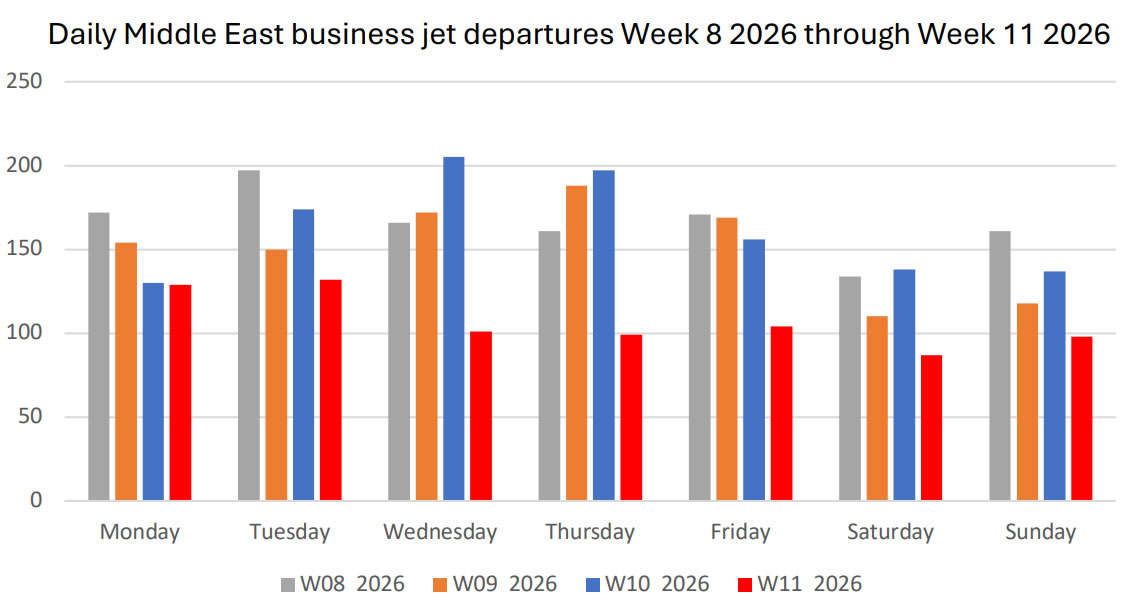
Middle East bizjet departures have followed a volatile trajectory since the conflict outbreak on 28 February. The pre-conflict baseline of 1,160 departures in Week 8 fell to 1,050 in Week 9 (-9%), a decline that understates the true shock given that the conflict only erupted on the final two days of that week. Week 10 showed a recovery which reflected a significant exodus from the region (1,140 departures; +7% week-onweek), before Week 11 broke decisively lower to just 750 departures (-34% week-onweek), the lowest weekly total since the conflict began. The day-by-day picture reinforces the deterioration, where Week 8 saw no single day fall below 130 departures, Week 11 saw no single day exceed 135, with Tuesday recording the week's high at just 132 flights.
Daily Middle East business jet departures Week 8 2026 through Week 11 2026.
click image to enlarge
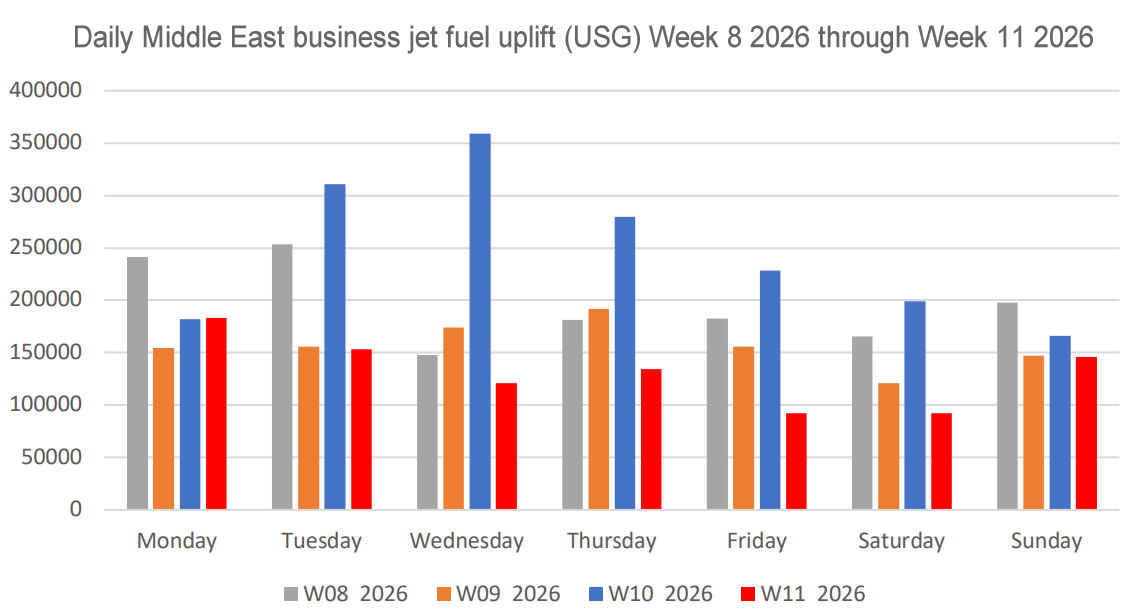
The fuel uplift picture tells an equally stark story. WINGX estimates that bizjet activity out of the Middle East in Week 8 represented a Jet-A1 fuel uplift of 1.369M USG in Week 8, which then fell to 1.099M USG in Week 9 (-20%). Week 10 saw a sharp increase to 1.725M USG (+57% week-on-week), consistent with longer-sectors as many exited the region. Week 11 then collapsed to just 922K USG (-47% week-on-week), the lowest fuel uplift recorded across the four-week window. Taken together, the departures and fuel uplift data point in the same direction, Week 11 represents the deepest operational disruption to Middle East bizjet activity since the conflict began.
Daily Middle East business jet fuel uplift (USG) Week 8 2026 through Week 11 2026.
click image to enlarge
Where did the jets go? Turkey emerges as the conflict’s repositioning hub
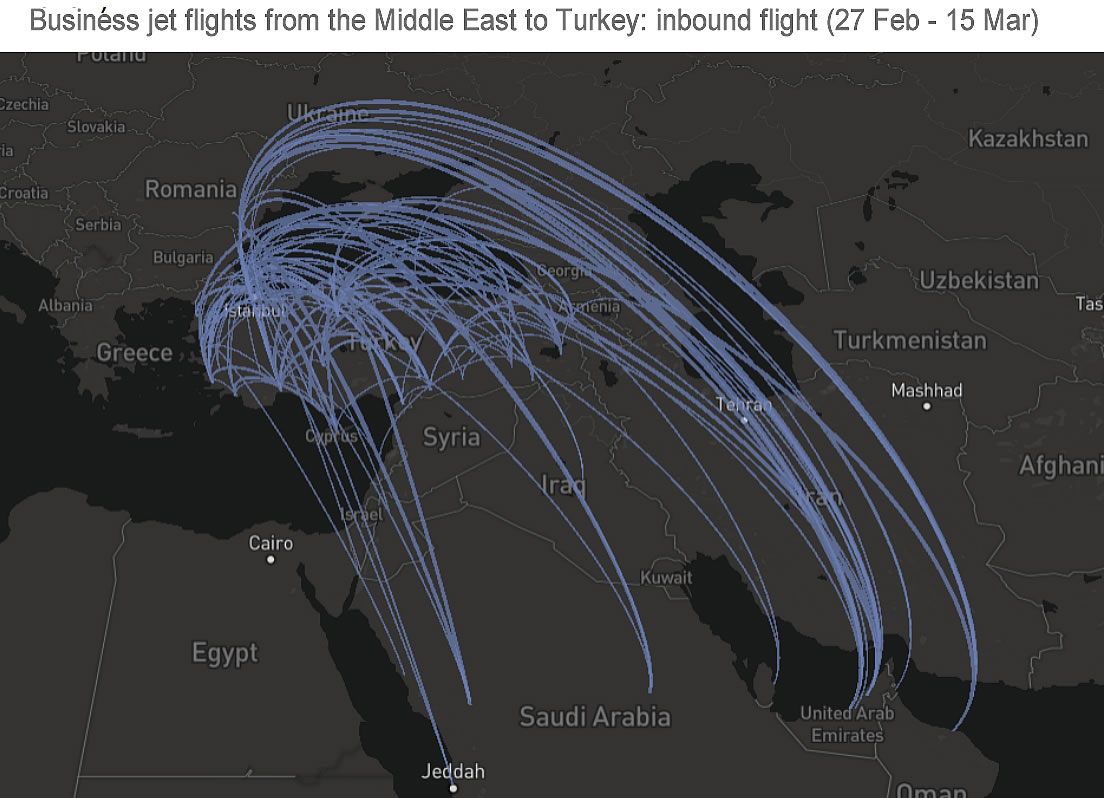
Turkey dominated as the primary destination for business jets departing the Middle East following the conflict outbreak, absorbing 410 flights and 26.7% of all Middle East departures in the 27 February-8 March window. This week, WINGX Ground Insight data allows us to look beyond that initial landing and ask the next question: once aircraft arrived in Turkey, where did they go?
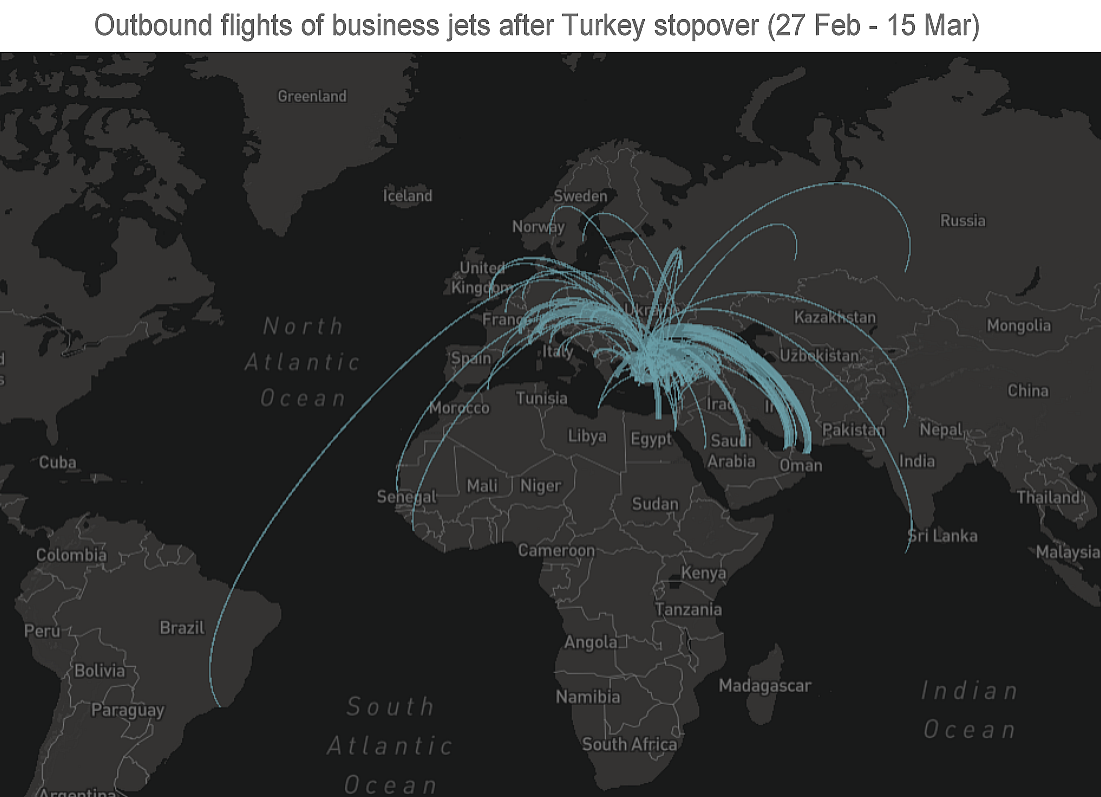
Across the full 27 February-15 March period, 545 flights from the Middle East made a stopover in Turkey, involving 166 unique tails parked across 42 Turkish airports, with an average parking duration of 20 hours, consistent with deliberate repositioning rather than routine technical stops.
The onward destination picture tells a striking story about operator intent. Of the 545 onward movements, 294 remained within Turkey itself, suggesting a large cohort of operators are holding position rather than committing to a further move. Beyond Turkey, the next most significant onward destinations were Oman (38 events) and the UAE (30 events), confirming that a meaningful share of displaced traffic is cautiously repositioning back toward the Gulf rather than fleeing westward. European destinations, Italy (13), Russia (11), France (7), Greece (7), have accounted for a comparatively modest share of onward movements.
Business jet flights from the Middle East to Turkey: inbound flight (27 February-15 March).
click image to enlarge
Outbound flights of business jets after Turkey stopover (27 February-15 March).
click image to enlarge
Parked business jets across the Middle East have more than halved since outbreak of conflict, with Dubai now fully cleared
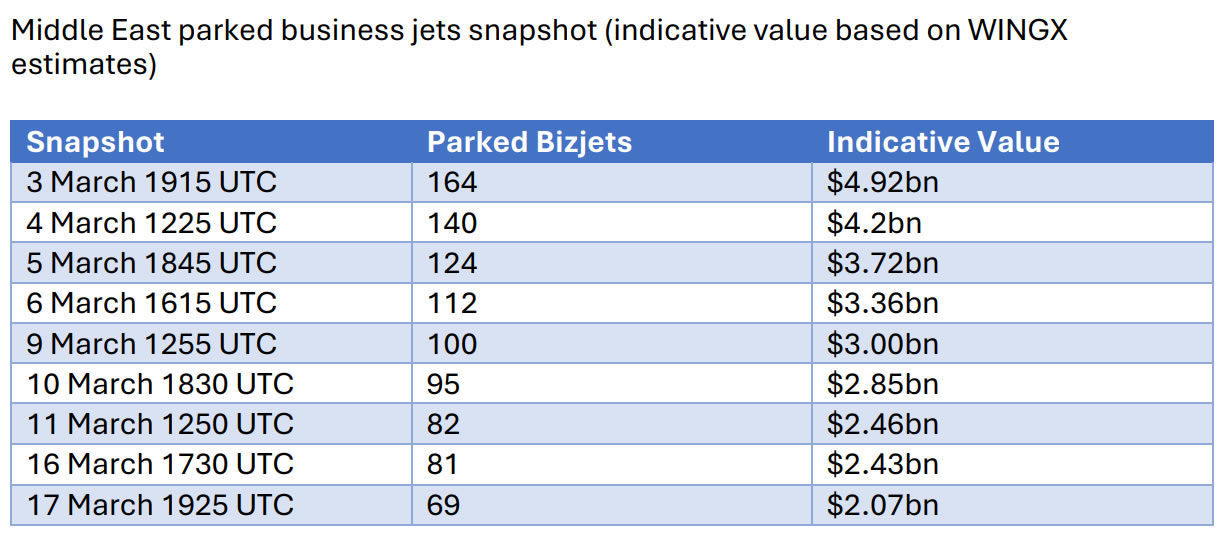
Of the business jets that departed the Middle East following the conflict outbreak, a significant portion repositioned to airports outside of the region, and WINGX parking data shows the decline of parked business jets in the Middle East. Since 28 February, the number of these grounded aircraft has declined steadily, falling from a peak of 164 recorded on 3 March 1915 UTC, representing an indicative fleet value of $4.92bn, to 69 aircraft by 17 March 1925 UTC, with an indicative value of $2.07bn still grounded in conflict-affected airports.
Middle East parked business jets snapshot (indicative value based on WINGX estimates)
click image to enlarge
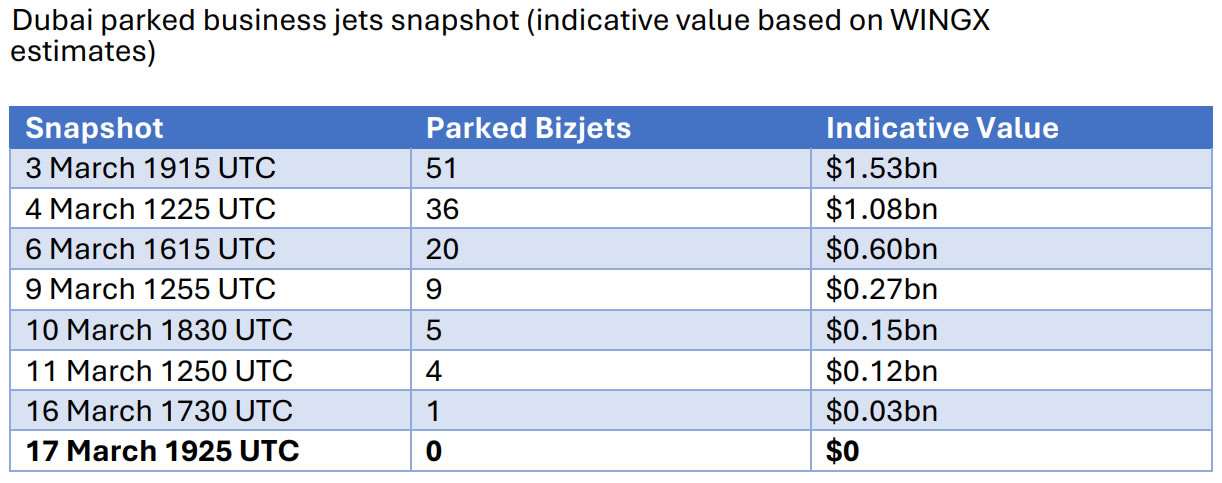
On a hub-city level, Dubai has shown one of the sharpest drops in the region. Parked bizjets at Dubai airports fell from 51 on 3 March to just 1 by 16 March, then reaching zero by 17 March, marking Dubai as the first major Middle East bizjet hub to fully clear its conflict-related groundings.
Dubai parked business jets snapshot (indicative value based on WINGX estimates).
click image to enlarge
Jet-A fuel prices surge to new highs as conflict enters third week
With three weeks of conflict-affected data now available, this bulletin moves from broad oil benchmark tracking to direct Jet-A fuel price analysis, the cost that operators actually pay at the pump. Platts Jet-A pricing data tells an unambiguous story: prices have not stabilized since the conflict outbreak, and in several markets are still climbing.
Against a pre-conflict baseline of approximately $2.11/USG for Arab Gulf and $2.45/USG for New York Harbor in the week of 23-27 February, Jet-A prices surged immediately following the outbreak. By 5-6 March, Arab Gulf had nearly doubled and NYH had reached 65% above pre-conflict levels. Jet-A prices have continued to climb through Week 11: by 12-13 March, Arab Gulf Jet-A had reached an average price of $4.74/USG, +124% above pre-conflict levels, and NYH was roughly 70% above preconflict pricing. European benchmarks including CIF NWE Cargo have realized a similar rise through the same period.
Scheduled airline departures show first signs of recovery in Week 11
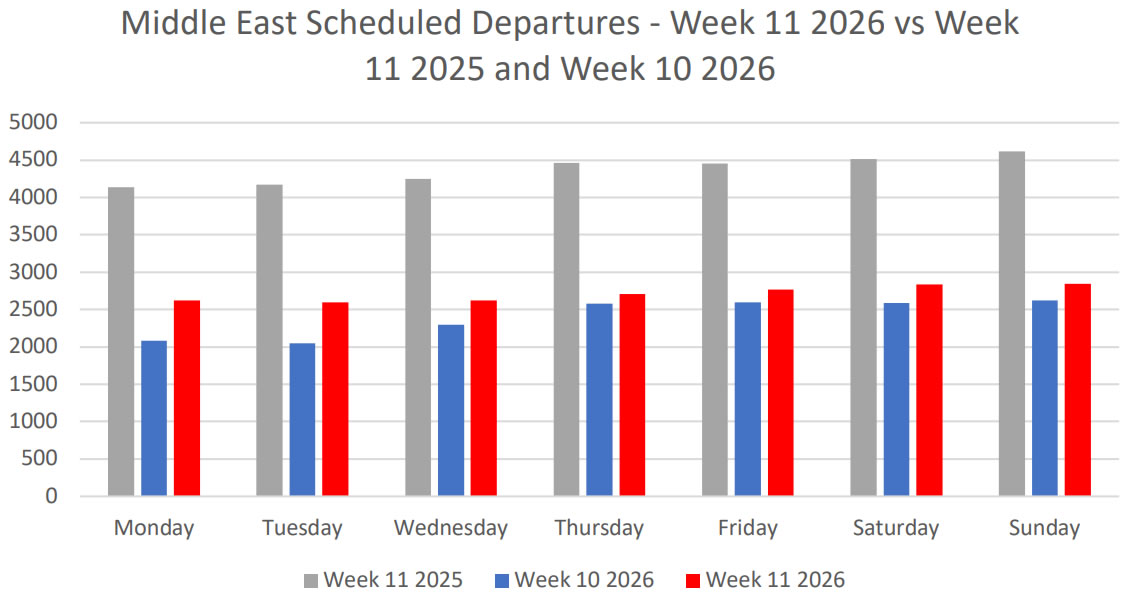
Middle East scheduled airline departures totaled approximately 19,000 in Week 11 2026, up 13% week-on-week from the 16,800 recorded in Week 10, the first sign of any recovery in scheduled services since the conflict began. However, against the 30,600 departures recorded in Week 11 2025, the region remains 38% below prior-year levels, underlining that while there was a bright week-on-week increase, the scale of disruption remains severe.
The day-by-day picture reflects a steady and broad-based improvement across the week, with daily departures climbing consistently from around 2,600 on Monday to nearly 2,850 by Sunday, a marked contrast to Week 10's flat trajectory where no recovery was visible across the week. The week-on-week improvement is an encouraging signal, but with scheduled departures still running at roughly two-thirds of normal levels, commercial aviation in the Middle East remains far from any return to pre-conflict operations.
For the 3-week period since the conflict began, business jet activity is down 22% YOY in the Middle East, compared to a 44% decline in scheduled airline flights.
Daily Middle East scheduled airline departures Week 11 2026 vs Week 10 2026 and Week 11 2025.
click image to enlarge
Global bizjet activity: How much is the Middle East dragging on global traffic?
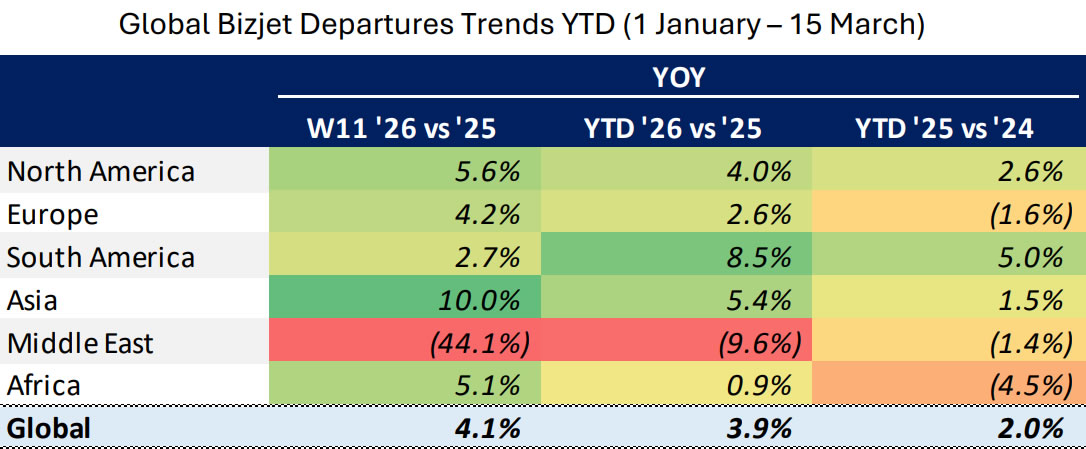
In Week 11, Middle East bizjet traffic accounted for approximately 1% of global activity, half its typical 2% share, while the region's -44.1% Week 11 performance suppressed global growth by roughly 0.4 percentage points. Africa's return to positive territory at +5.1% in Week 11 removes the secondary drag seen in previous weeks, suggesting the airspace contagion effects that weighed on African traffic in Weeks 9 and Week 10 may be easing. Put another way, global bizjet growth would be running closer to 4.5% in Week 11 rather than 4.1% were it not for the conflict's continued footprint in the region.
The broader picture remains resilient. Global bizjet activity reached +4.1% YOY in Week 11, with the year-to-date figure holding steady at +3.9%, consistent with the growth rate reported last week and a notable acceleration from the +2.0% achieved over the same period in 2025 vs 2024. North America continues to anchor growth at +5.6% in Week 11 and +4.0% YTD, while Asia delivered a standout +10.0% in the week.
The Middle East's YTD figure has now deteriorated to -9.6%, its worst reading since the conflict began, reflecting the cumulative weight of three consecutive weeks of severely suppressed activity. For now, strength across North America, Europe, and Asia is absorbing the drag, but the Middle East's YTD hole is deepening with each passing week.
Global Bizjet Departures Trends YTD (1 January-15 March).
click image to enlarge
Nick Koscinski, WINGX Analyst, comments: "Week 11 has erased the cautious optimism of Week 10. The 44% year-on-year decline is the sharpest we have recorded since the conflict began, and with Jet-A prices continuing to climb, operators across the region are facing a double headwind of suppressed demand and soaring fuel costs.
"The question heading into Week 12 is now how much longer operators can sustain this level of disruption before the cost of sitting on the sidelines outweighs the risk of returning to the region."



"Week 11 has erased the cautious optimism of Week 10. The 44% year-on-year decline is the sharpest we have recorded since the conflict began, and with Jet-A prices continuing to climb, operators across the region are facing a double headwind of suppressed demand and soaring fuel costs.
"The question heading into Week 12 is now how much longer operators can sustain this level of disruption before the cost of sitting on the sidelines outweighs the risk of returning to the region."
Nick Koscinski
WINGX Analyst
WINGX GmbH
Lilienstraße 11
20095 Hamburg
Germany.
+49 40 23 96 85 05
BlueSky Business Aviation News | 19th March 2026 | Issue #834

| © BlueSky Business Aviation News Ltd 2008-2026 |