


WINGX Global Market Tracker:
Iran-Israel-US conflict disrupts aviation across Middle East
The outbreak of armed conflict between Iran, Israel, and the United States on 28 February has sent an immediate and measurable shockwave through business aviation throughout the Middle East.
WINGX data shows a sharp contraction in business jet departures and a disruption to commercial airline schedules across the region’s major hubs. Below, we examine four dimensions of the impact.
Middle East Bizjet Departures: Last Two Weeks (16 February-1 March)
Chart 1 below shows total business jet departures from Middle East airports on a dayby-day basis across the two weeks prior to and including the conflict outbreak. The sharp drop from 28 February (Saturday in Week 9) is immediately visible, illustrating how quickly the shock translated to a disruption in bizjet traffic.
Daily Middle East business jet departures 16 February-1 March.
click image to enlarge
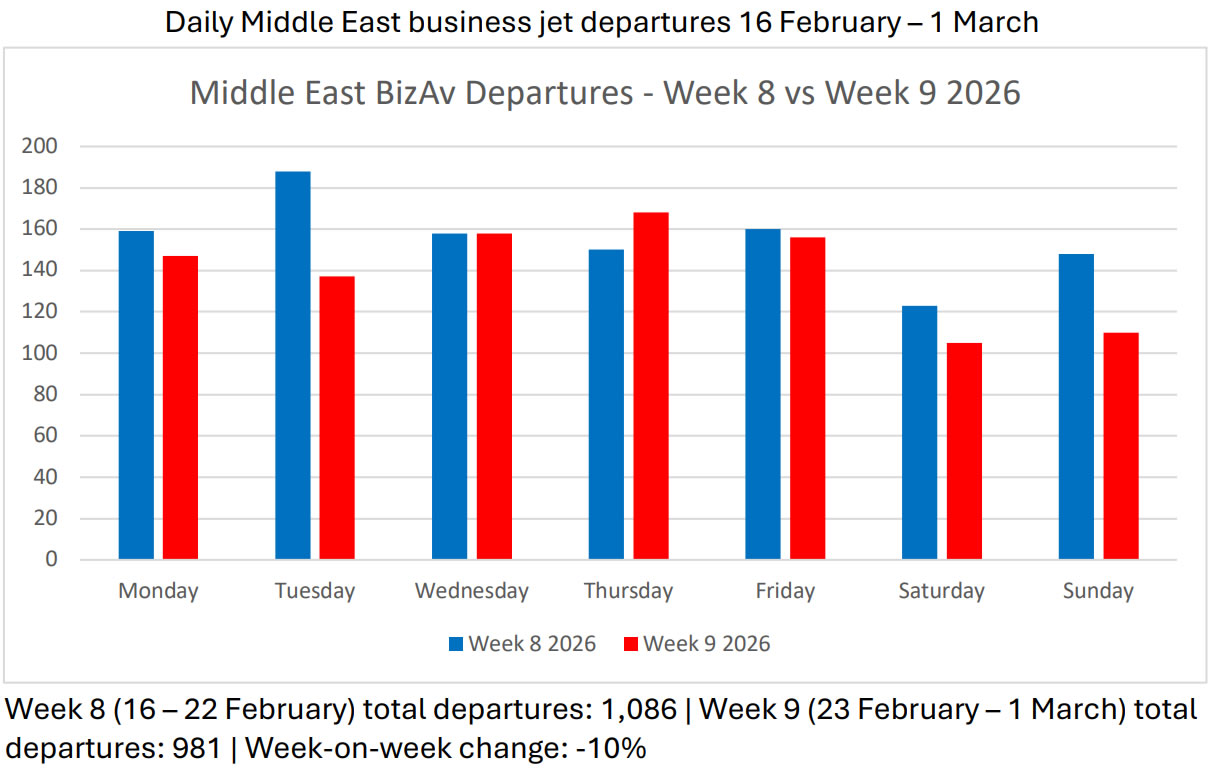
Week 8 (16-22 February) total departures: 1,086 | Week 9 (23 February-1 March) total departures: 981 | Week-on-week change: -10%
Where did the jets go? Top destinations 27 February-1 March
Despite the overall collapse in departures, 371 business jet flights did depart Middle East airports in the 27 February-1 March window. The destination mix tells a clear story: aircraft fled primarily to neighboring and near-regional markets, with a notable tilt toward countries offering geographic proximity and operational continuity. The biggest drops were in flights within the region, for example 60% reduction in flights to and within Saudi Arabia.
Middle East business jet departures arrival countries 27 February-1 March.
click image to enlarge
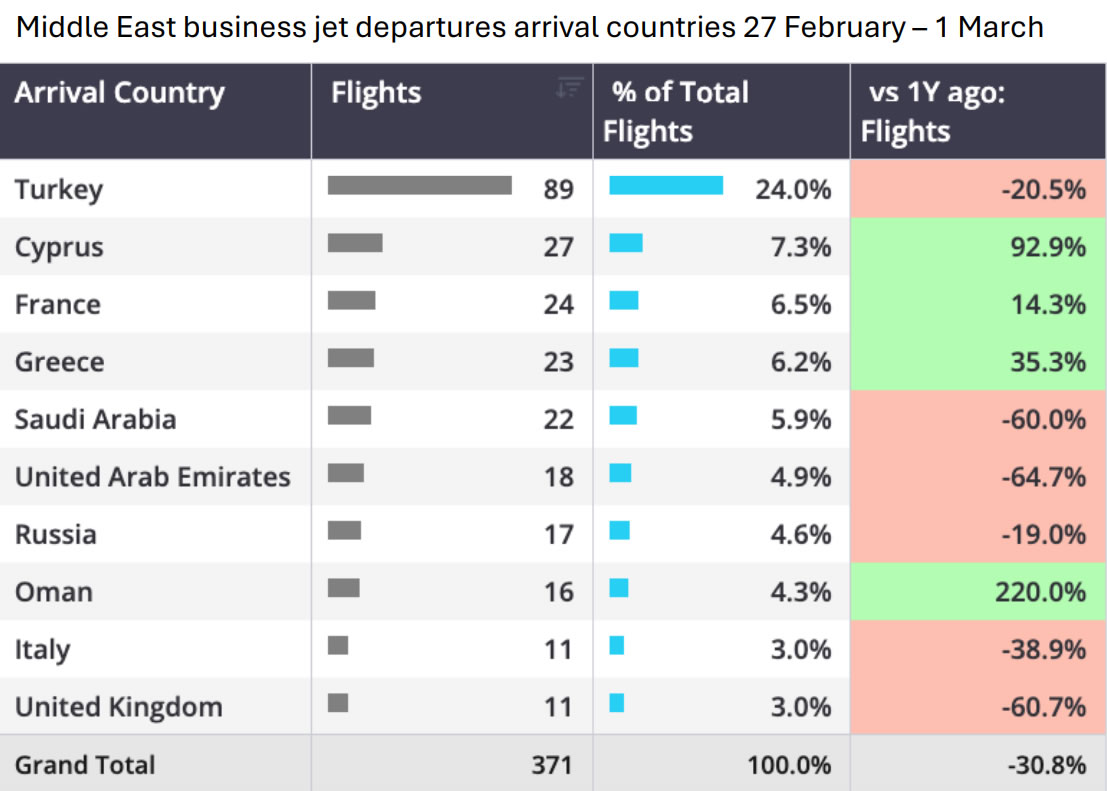
“vs 1Y ago: Flights” refers to flights during the same dates last year (27 February-1 March 2025)
Turkey dominated as the top destination country, absorbing nearly a quarter of all flights, this was still notably 20.5% below the same period a year ago, suggesting that while Turkey was the top arrival country, it still felt the impact of the conflict.
On the European side, France, Greece, Italy, and the UK collectively drew 18.7% of the traffic escaping the Middle East. Overall, the 30.8% decline in total outbound flights vs the same period last year underscores the severity of the demand shock in the Middle East.
Parked business jets across the Middle East
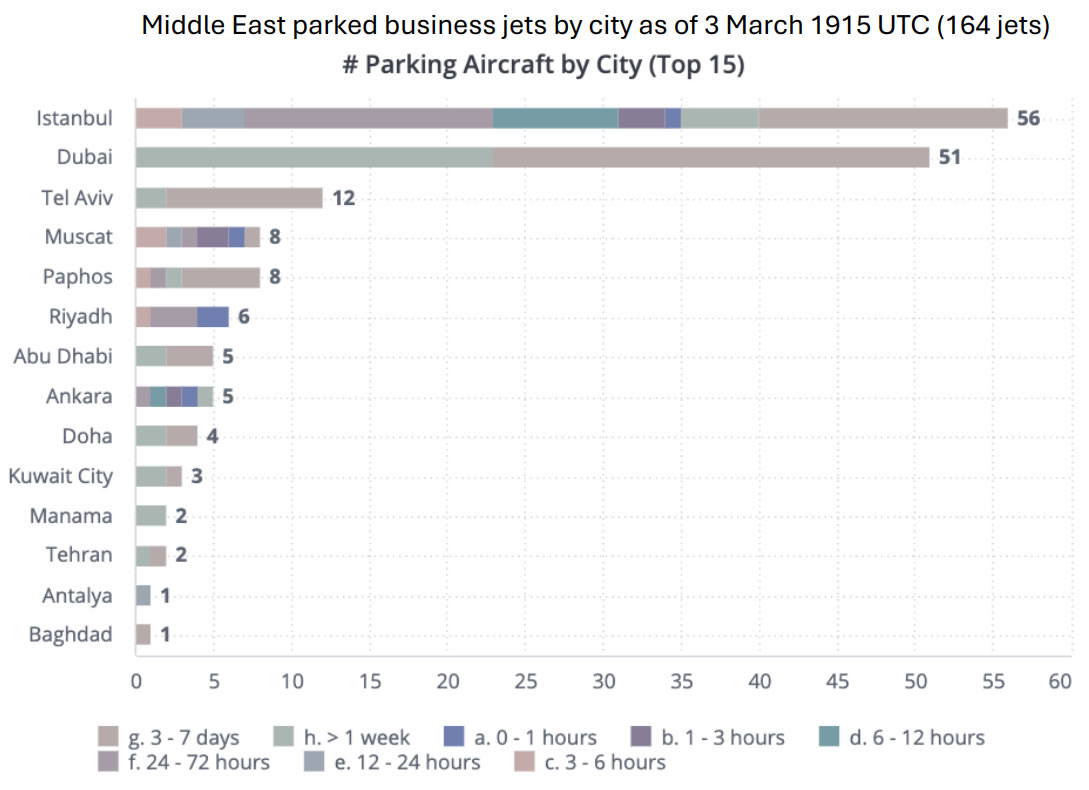
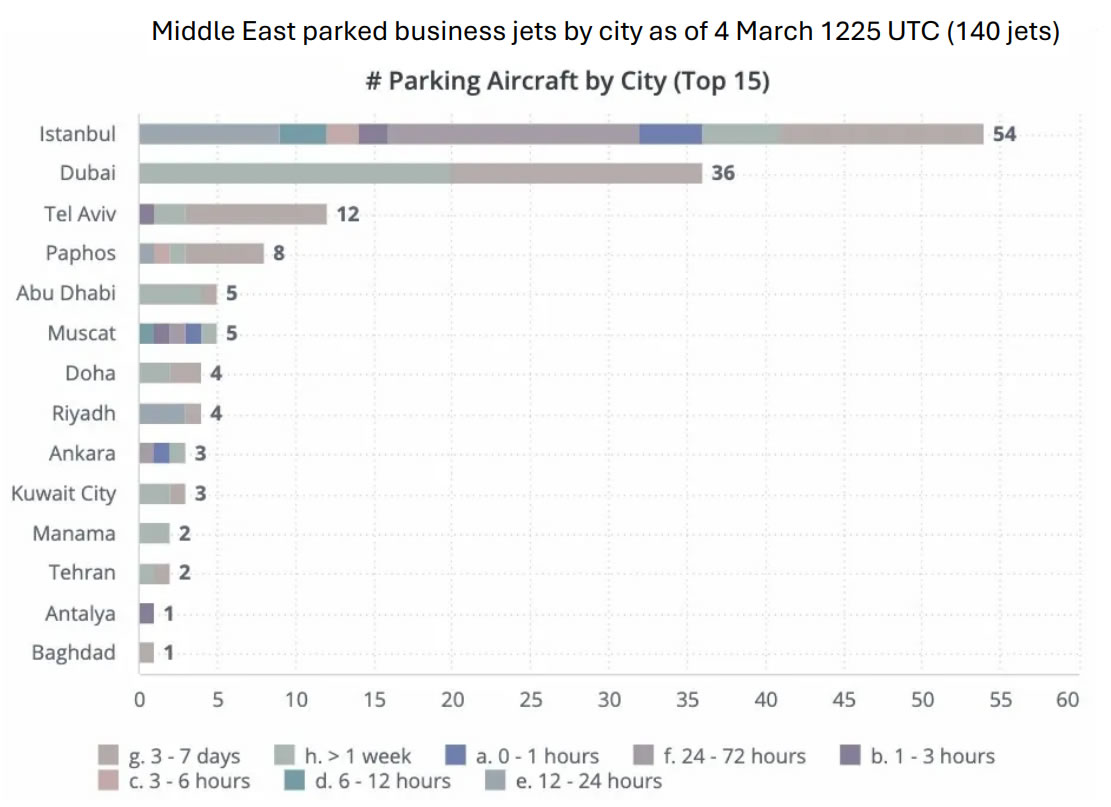
As of 3 March 19:15 UTC, WINGX live parking data shows 164 business jets grounded across Middle East airports, with an average parking duration of 4.5 days, which places the bulk of these groundings squarely in the post-conflict window beginning 28 February. By 4 March 12:25 UTC, the total had edged down to 140 aircraft, though the average parking duration had extended to 4.9 days, suggesting that while some aircraft had begun to move, those remaining are increasingly entrenched.
Istanbul leads both snapshots, reflecting its role as the primary repositioning hub for jets that departed the region in the immediate aftermath of the conflict. Dubai is the 2nd top city, with all parked aircraft having been grounded for 3 days or more.
Middle East parked business jets by city as of 3 March 19:15 UTC (164 jets).
click image to enlarge
Middle East parked business jets by city as of 4 March 12:25 UTC (140 jets).
click image to enlarge
Disruption to Airline and Cargo Activity: 23 February-1 March
Business jet groundings sit within a broader aviation freeze across the Middle East. Below we examine the parallel impact on commercial passenger services and air cargo operations, both critical to understanding the full scale of the regional disruption.
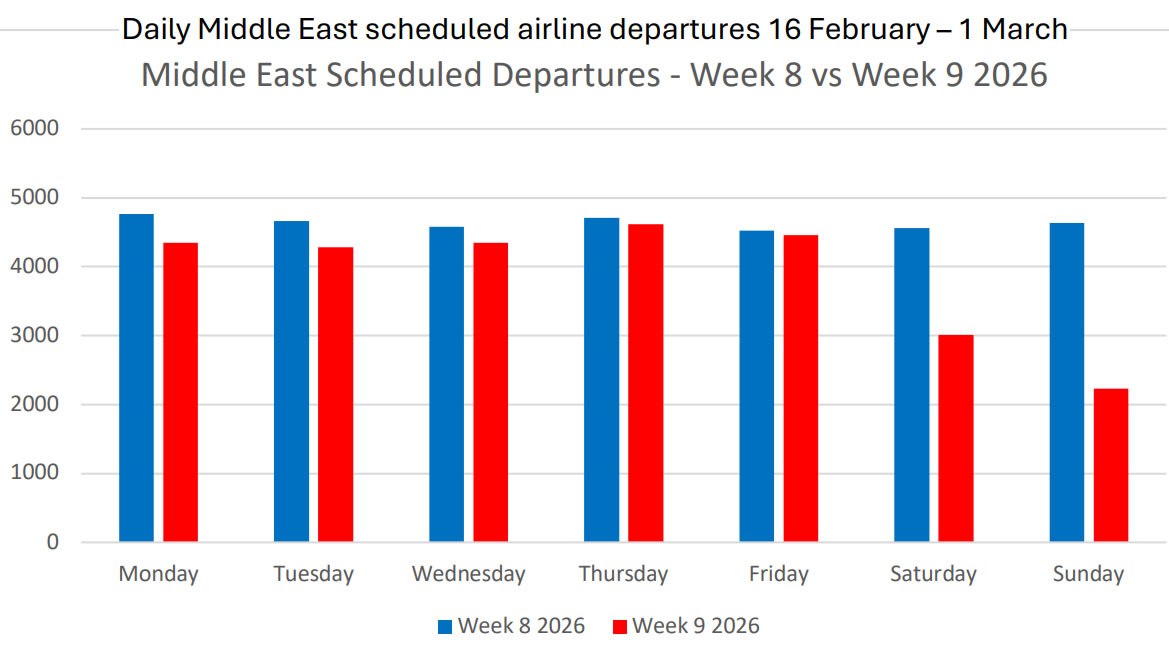
Commercial passenger services across the Middle East tracked broadly normal through Friday 27 February before deteriorating sharply on 28 February as airspace restrictions took effect and carriers began suspending routes. Chart 3 compares scheduled airline departures day-by-day between Week 8 (16-22 February) and Week 9 (23 February-1 March), illustrating the moment the floor gave away on Saturday 28 February.
Daily Middle East scheduled airline departures 16 February-1 March.
click image to enlarge
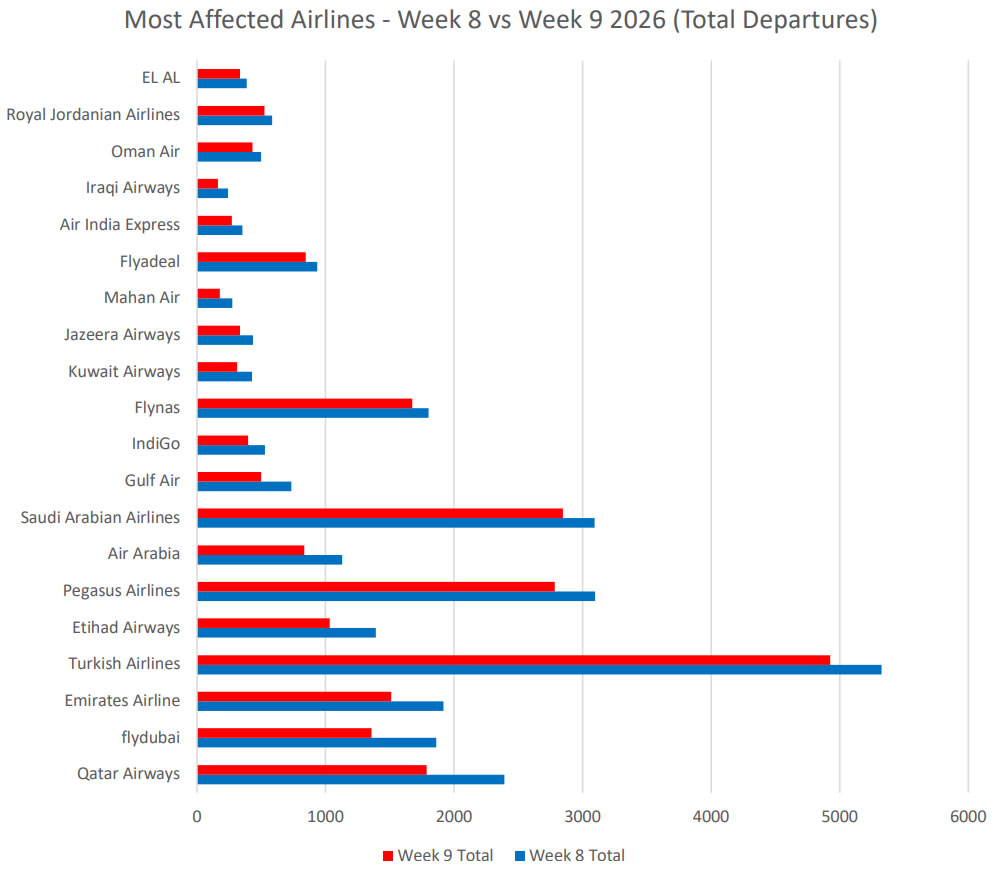
Across the top 20 airlines that departed the Middle East from 16 February-1 March, every carrier recorded week-on-week declines between Week 8 and Week 9. The Gulf majors absorbed the heaviest losses, Qatar Airways (-25%), flydubai (-27%), Emirates (-21%), and Etihad (-26%), while Mahan Air posted the steepest decline in the dataset at -35%, reflective of Iran’s direct involvement in the conflict. Turkish Airlines proved the most resilient, declining just 8%, consistent with Istanbul’s emergence as the primary destination for repositioning traffic.
Most affected airlines Week 8 vs Week 9 (16 February-1 March).
click image to enlarge
The disruption extended into air freight, with 468 cargo departures recorded across 23 February-1 March window, down 19% compared to the same dates last year. Dubai led cargo activity with 116 departures but saw a steep decline of 30% YOY, reflecting the UAE’s outsized exposure to the conflict despite not being a direct combatant.
Manama (96 flights, -17% YOY) and Istanbul (90 flights, -16% YOY) followed, with Istanbul’s relative resilience again consistent with its role as a regional fallback hub. The implications extend beyond aviation: the Middle East serves as a critical transit corridor and even a short-duration disruption can create downstream supply chain bottlenecks.
Is there a discernible dent in global bizjet activity?
The Middle East typically represents only 2% of global business jet departures in normal conditions, small enough that a regional shock might be absorbed by growth elsewhere. Week 8 data suggests that this is the case, with the rest of the world holding the line, even as the Middle East hemorrhages traffic.
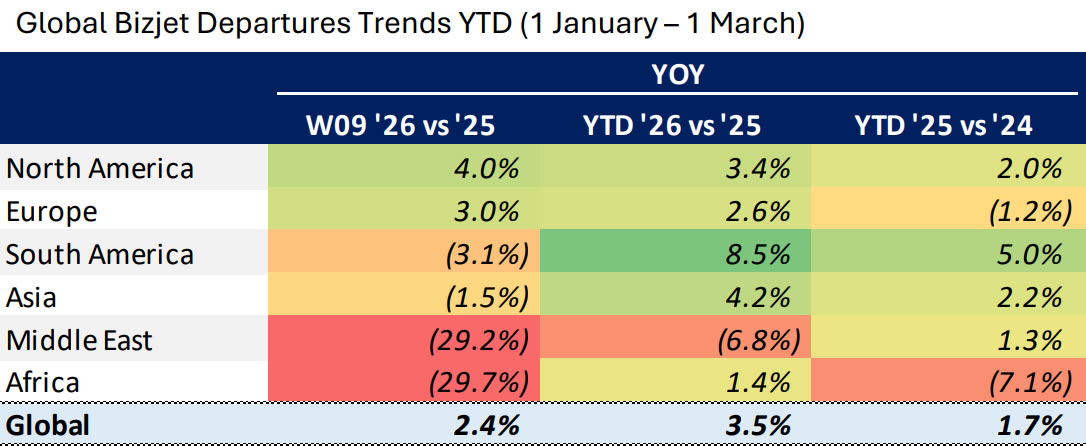
Globally, bizjet traffic in Week 9 (23 February-1 March) was up 2.4% compared to Week 9 last year, and the year-to-date figure stands at a healthy 3.5%, an acceleration on the 1.7% growth achieved over the same period in 2025 vs 2024. North America continues to anchor weekly growth at 4.0%, +3.4% YTD, while Europe is tracking 3.0% in Week 9 and +2.6% YTD. South America’s +8.5% YTD figure confirms its status as the standout emerging market, even with a softer Week 9.
The Middle East, by contrast, swung to -29.2% in Week 9 2026 vs 2025, and is now -6.8% year-to-date through 1 March (the region was -3.1% YTD through 22 February). Africa’s 29.7% Week 9 decline likely reflects the impact of regional airspace disruption, its YTD trend now sitting at +1.4%. At the global level, the 2.4% Week 9 growth suggests that growth in the North America and Europe markets is strong enough to absorb the significant declines in the Middle East and Africa, but sustained conflict would test that resilience as the YTD trend begins to incorporate more conflict-affected weeks.
Global Bizjet Departures Trends YTD (1 January-1 March).
click image to enlarge



France, Greece, Italy, and the UK collectively drew 18.7% of the traffic escaping the Middle East.
Overall, the 30.8% decline in total outbound flights vs the same period last year underscores the severity of the demand shock in the Middle East.
WINGX GmbH
Lilienstraße 11
20095 Hamburg
Germany.
+49 40 23 96 85 05
BlueSky Business Aviation News | 5th March 2026 | Issue #833

| © BlueSky Business Aviation News Ltd 2008-2026 |